
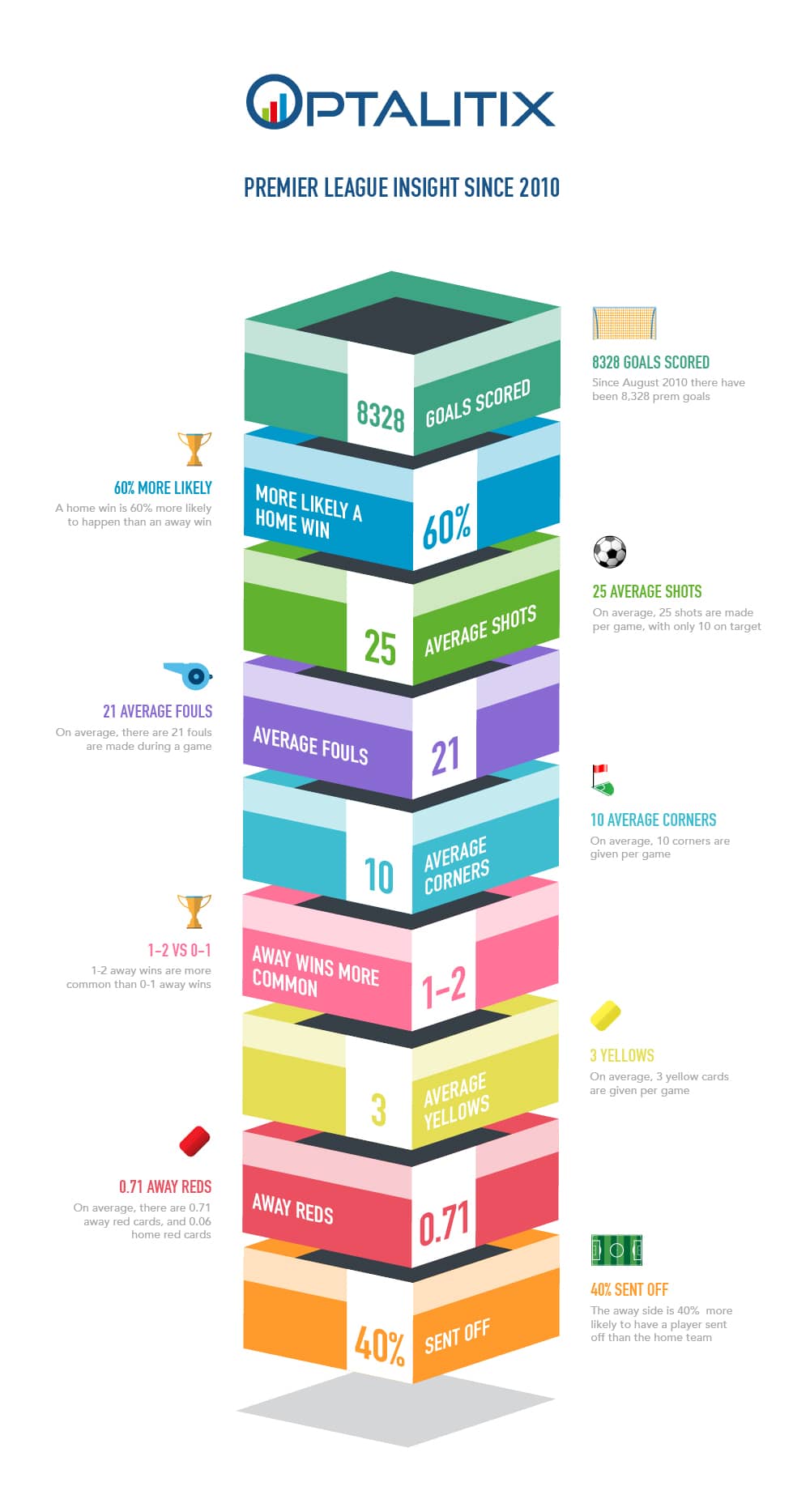
What is the most common Premier League scoreline? What should you expect to see more of in a game, fouls or shots at goal? Which team is more likely to have a player sent off, the home side or the visitors?
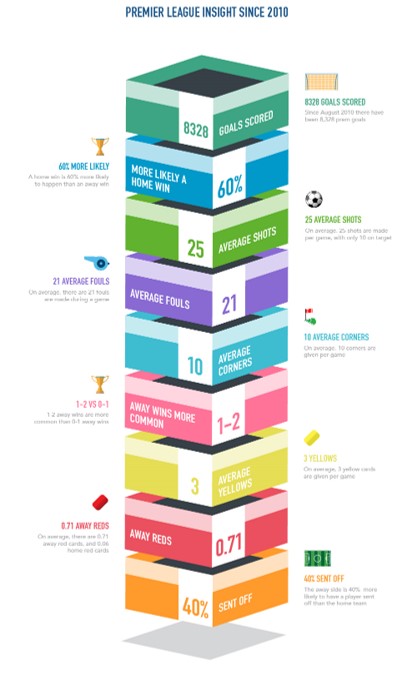
The football fans among you will no doubt have their answers to these questions ready by the end of this sentence. In fact, I reckon that even some of the casual fans will be giving these questions a moment’s thought. If you want to know the answers to these questions – along with many other Premier League (PL) stats – then the accompanying infographic is for you. If, however, you’re slightly curious as to how we got these numbers in the first place, read on.
Still, before we get to the good stuff, we need to go through the proper introductions.I work as an analyst for Optalitix, a company that delivers cutting edge, data based services, including database management and data analytics. I’m also a long-time supporter of a certain PL football team (name withheld for feeble reasons) and if there’s one thing I’ve learnt, it’s that there’s no quicker way than to win a tribal argument lively debate with a rival fan than with cold hard stats.
Why did we carry out this analysis into PL data? There are a number of answers. Football, like all sports, is awash with randomness and probabilities – being the data nerds that we are, the idea of being able to explain away the randomness, and quantify the unquantifiable, piqued our curiosity. We’d also recently finished work on an API modelling tool and were keen to see its application on something other than client data. Football data also has the advantages of being plentiful (if you’ve ever watched a football game on TV, you’ll have seen how frequently statistics flash up on the screen), not confidential and easily understandable by almost anyone who doesn’t live under a rock (or in the USA).
Besides, with the new Premier League season kicking off, could you really blame us for getting a little carried away with the whole football theme?
In order to carry out our research, we obtained historic data for the past 8 PL seasons (2010/11 – 2017/18). We didn’t go any further back – to, for instance, the inception of the PL in 1992 – because we assumed the relevance of the data decreases the further into the past you go (much to the chagrin of all Liverpool/Arsenal/Manchester United supporters).
Once we had compiled the data, we were able to look for key trends and patterns in the data (and settle some age-old debates with various colleagues). The fabled “home advantage” seemed like a good place to start - 57% of all goals are scored by the home side, and victory for the home team is the outcome of 46% of all matches. Needless to say, we soon found ourselves pretty far down the rabbit hole – did you know that Crystal Palace would have been relegated last season if all matches ended at half-time? And that they would have been just 1 point away from European football if only the second half of games counted?
The most common PL scoreline, by the way, is 1-1. I’ll leave it up to you to decide why that is.
Yoni Greis

Create a claims triage system using Excel logic
With claims, departments need to be able to filter out valid claims and pay them quickly amongst other tasks. See how Excel helps make a claims triage system.

Boost sales with an insight sales model
Generating sales will often cost time and money, particularly in the insurance sector. Learn how smart tools can help manage costs using Optalitix Models here.
Create a claims forecasting system
Calculating claims is vital for insurers as it can take months or even years for the claim payments after an insurance event to emerge. Learn more now.
Create a pricing application from a spreadsheet pricing model
When setting a price for a new product, the starting point is almost always Excel. Find out how to create a pricing application from a spreadsheet pricing model here.

Optalitix Models Use Cases
Insurance often involves using pricing models in spreadsheets. Use Optalitix Models to simplify processes by transforming these spreadsheets into a system.
Is the future of Lloyd’s algorithmic? - Part 2
Smart Follow underwriting and the algorithmic technology will bring a revolution of improved pricing and lower costs to insuring large and complex risks.
Is the future of Lloyd’s algorithmic? - Part 1
Take a look at a report that considers the impact of algorithmic underwriting on Lloyd’s and the London Market where complex risks are often underwritten..
Optalitix and Almagro Capital announce a new partnership that provides Almagro Capital with a rapid online quoting tool for its forthcoming expansion
Optalitix and Almagro Capital have agreed to partner to create improved pricing tools for Almagro and its brokers. Read more about their partnership in here.
The emergence of digital exchanges in the London Insurance Market
The Optalitix team were invited to contribute to a discussion where the digitisation on the underwriting process for the London Market. Read our insights here.
Iotatech and Optalitix announce the successful integration of their products providing significant added value to Iotatech’s clients
Iotatech and Optalitix are pleased to announce the successful integration of their platforms aimed at creating added value for clients of the Iotatech Platform.

Case Study: Catastrophe Reporting - Lloyd's of London
Learn how the London market could benefit from greater levels of digitisation and automation by converting data into cloud-based systems using low code software
Verto syndicate 2689 and Optalitix announce partnership - Press Release
Verto syndicate 2689 (Verto), a follow-only Lloyd’s syndicate, and Optalitix, an award-winning Insurtech company providing SaaS software to leading UK insurers.
FCA disrupts the insurance market
The FCA has changed the game for more established players in the insurance sector with its significant gear change in pricing for insurance business. Read more.
Optalitix Quote, the innovative new product for underwriters
Optalitix Quote is a new cloud product that enables underwriters using spreadsheets to improve their pricing processes. Learn more about it in this handy guide.
Insurance innovation – what will 2022 bring?
What might we expect for insurance in 2022? From digital insurance marketplaces to wellness products and profitability, read our predictions and more.