
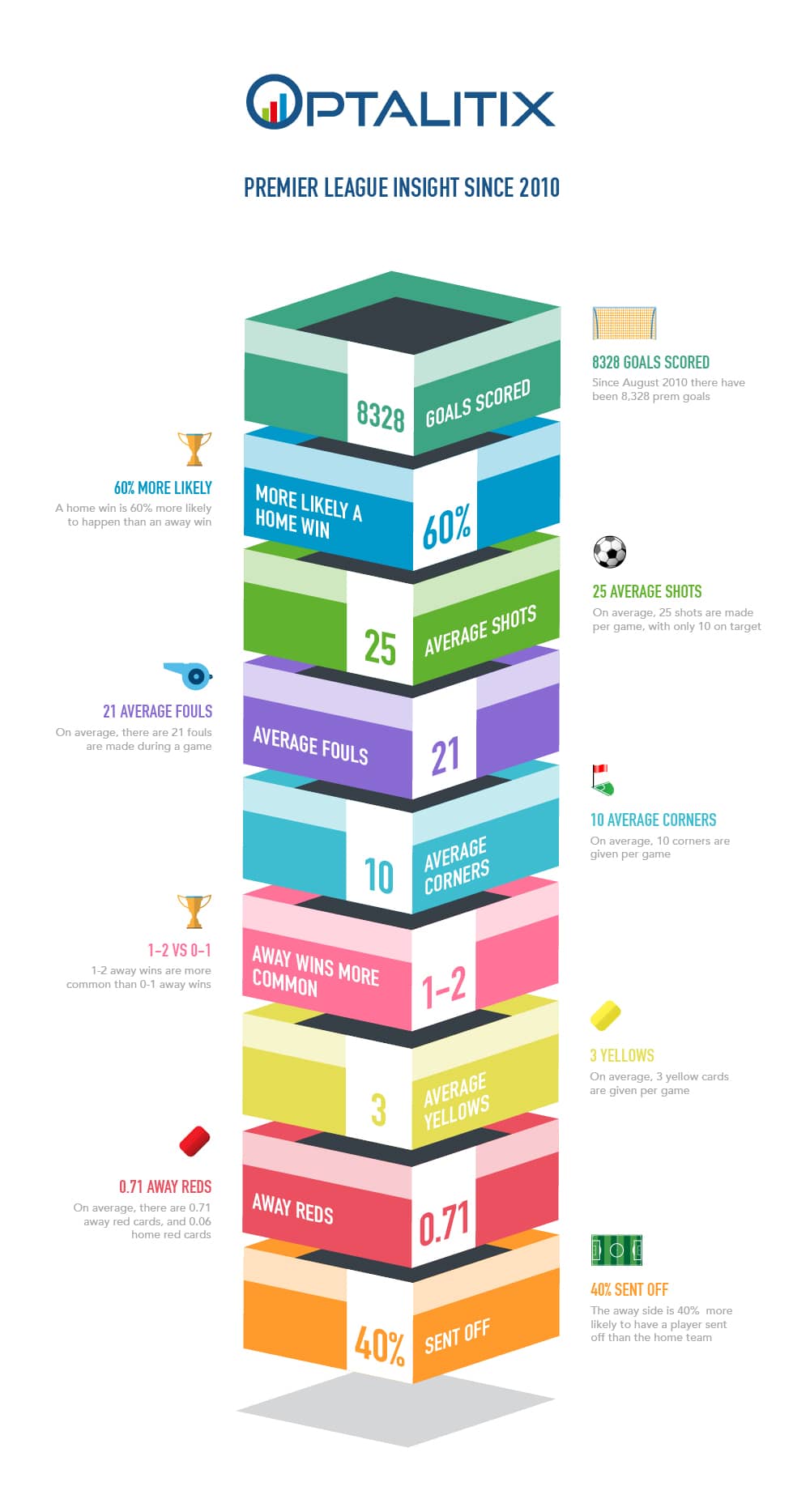
What is the most common Premier League scoreline? What should you expect to see more of in a game, fouls or shots at goal? Which team is more likely to have a player sent off, the home side or the visitors?
The football fans among you will no doubt have their answers to these questions ready by the end of this sentence. In fact, I reckon that even some of the casual fans will be giving these questions a moment’s thought. If you want to know the answers to these questions – along with many other Premier League (PL) stats – then the accompanying infographic is for you. If, however, you’re slightly curious as to how we got these numbers in the first place, read on.
Still, before we get to the good stuff, we need to go through the proper introductions.I work as an analyst for Optalitix, a company that delivers cutting edge, data based services, including database management and data analytics. I’m also a long-time supporter of a certain PL football team (name withheld for feeble reasons) and if there’s one thing I’ve learnt, it’s that there’s no quicker way than to win a tribal argument lively debate with a rival fan than with cold hard stats.
Why did we carry out this analysis into PL data? There are a number of answers. Football, like all sports, is awash with randomness and probabilities – being the data nerds that we are, the idea of being able to explain away the randomness, and quantify the unquantifiable, piqued our curiosity. We’d also recently finished work on an API modelling tool and were keen to see its application on something other than client data. Football data also has the advantages of being plentiful (if you’ve ever watched a football game on TV, you’ll have seen how frequently statistics flash up on the screen), not confidential and easily understandable by almost anyone who doesn’t live under a rock (or in the USA).
Besides, with the new Premier League season kicking off, could you really blame us for getting a little carried away with the whole football theme?
In order to carry out our research, we obtained historic data for the past 8 PL seasons (2010/11 – 2017/18). We didn’t go any further back – to, for instance, the inception of the PL in 1992 – because we assumed the relevance of the data decreases the further into the past you go (much to the chagrin of all Liverpool/Arsenal/Manchester United supporters).
Once we had compiled the data, we were able to look for key trends and patterns in the data (and settle some age-old debates with various colleagues). The fabled “home advantage” seemed like a good place to start - 57% of all goals are scored by the home side, and victory for the home team is the outcome of 46% of all matches. Needless to say, we soon found ourselves pretty far down the rabbit hole – did you know that Crystal Palace would have been relegated last season if all matches ended at half-time? And that they would have been just 1 point away from European football if only the second half of games counted?
The most common PL scoreline, by the way, is 1-1. I’ll leave it up to you to decide why that is.
Yoni Greis

How to get underwriting efficiency. Workflow and the underwriting workbench
Improve underwriting efficiency with Optalitix's workflow and workbench expertise. Our tools handle various processes, quotes, and large underwriting departments.

A practical guide to underwriting workbenches
Explore how our underwriting workbench aids insurers in handling incoming risks, monitoring their risk profile, and aligning management with their risk appetite.
Optalitix celebrates 10 years!
Optalitix products now available on Google Cloud Marketplace
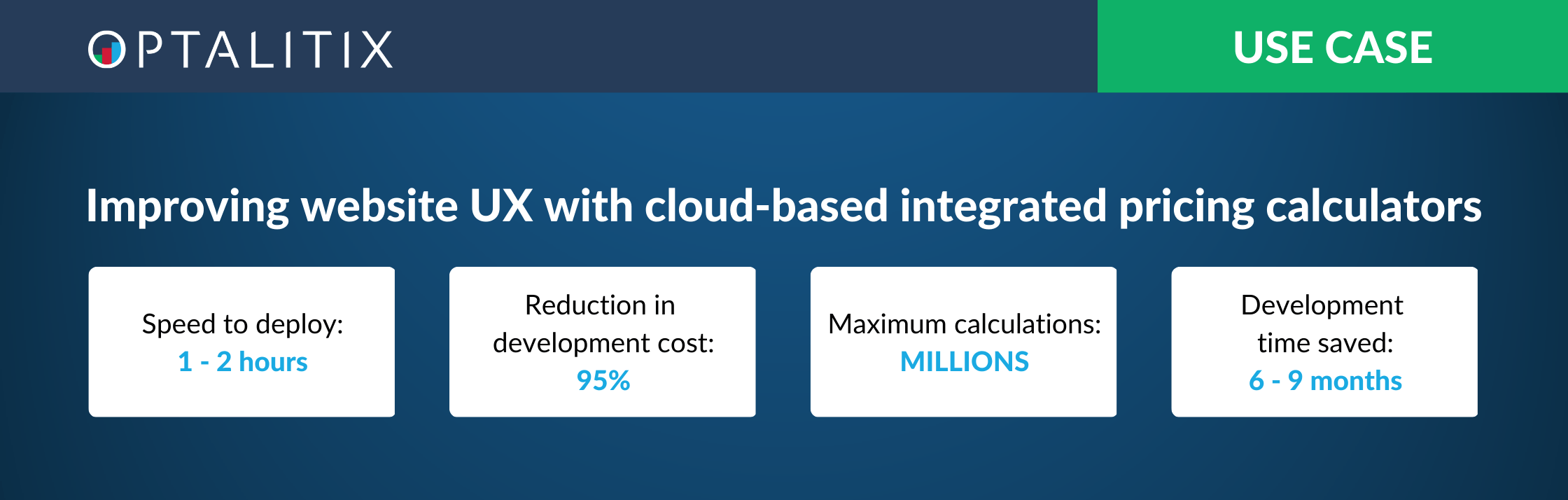
Onespark use case: Improving website UX with cloud-based integrated pricing calculators
Building a pricing calculator into a CRM for Almagro Capital
Almagro wanted a calculator for their products to be built into the Zoho CRM system. Find out how Optalitix Models connected the Almagro CRM system in Zoho here.
Meet Optalitix at Insurtech Insights EU 2023
The Insurech Conference connects insurers and investors, offering an unparalleled experience and access to industry innovators. Explore 2023 Conference insights!
Optalitix appoints Paul Hewitt to their Board following the investment into Optalitix by 24Haymarket
Paul Hewitt has been appointed to the Board of Optalitix, advising on insurance strategy, product development and industry partnerships. Read more in this guide.
.jpeg)
Building a pricing system from a spreadsheet
Have you got an Excel pricing model that you would love to turn into a system? Find out how to build a pricing system from a spreadsheet in our guide.
Optalitix & Avamore launching new lending platform using Optalitix Originate
Optalitix Client Avamore will be launching its new core lending platform using Optalitix Originate architecture. Read more about the platform and its targets.
Optalitix Models integrates easily with Retool to create no-code apps from spreadsheets
Spreadsheet-based calculations representing real-world situations are referred to a models. See how to convert yours into usable application software here.
Optalitix announces that it has achieved the prestigious ISO 27001 certification
OOptalitix announced it has achieved the prestigious ISO 27001 certification by implementing an Information Security Management System (ISMS). Read more here
New pricing standards at Lloyd's require improvements in underwriting systems
New principles for doing business at Lloyd’s will encourage syndicates to digitise their processes, especially underwriting. Find out more here.
Learn about insurance innovation from the DIA conference
The Dia Munich Conference, in 2022, showcased cutting-edge insurance technology, highlighting the growing fusion of insurance and technology in mainland Europe.
Optalitix raises £4m of funding for growth
Optalitix is an award-winning technology business that adds value to financial institutions with low code SaaS products, data analysis and AI models. Read more.