
The Year of the MGA: How MGAs Are Reshaping the Insurance Industry
MGAs are becoming a major force in insurance. Dani Katz explores what their growth means for underwriting, technology, reinsurers and traditional insurers.


The Year of the MGA: How MGAs Are Reshaping the Insurance Industry
By Dani Katz, Co-founder, Optalitix
The rise of Managing General Agents (MGAs) is becoming oneof the most significant structural changes in the insurance industry. What wasonce a relatively small, specialist segment is rapidly becoming a mainstreampart of the market, attracting capital, capturing premium growth andchallenging the traditional relationships between brokers, insurers andreinsurers.
In my previous article, The Year of the MGA, Iexplored how MGAs were using technology to transform their pricing capabilitiesand support rapid growth. The latest industry research on MGAs suggests this ispart of something much bigger. MGAs are changing the way insurance business isoriginated, underwritten and financed.
Industry participants need to understand this, and theimpact it could have on their business especially in a softer market wheregrowth and profits may be harder to find. To compete as an MGA or primaryinsurer in this market requires a start-up mentality, greater risk taking and support fromtechnology.
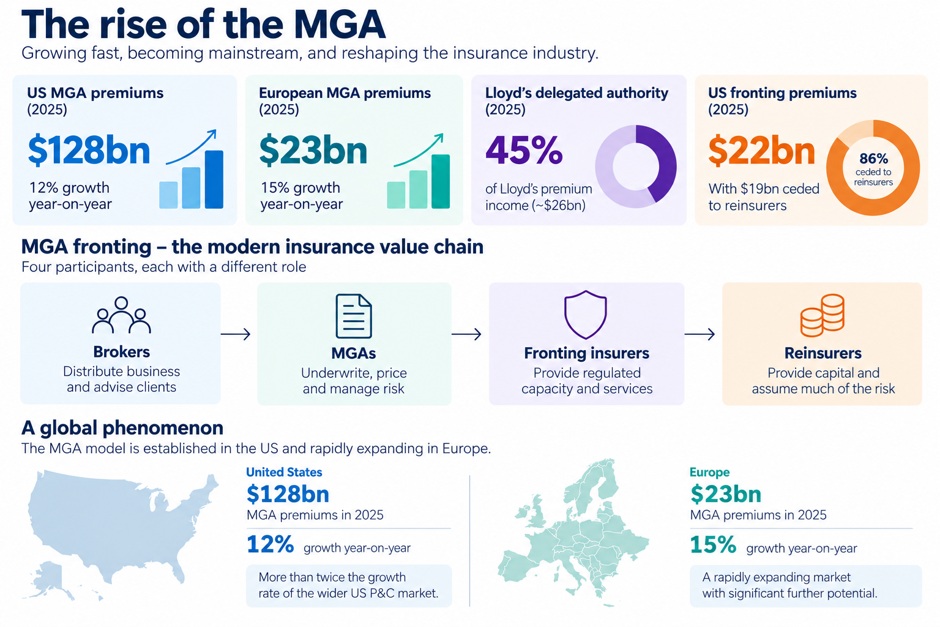
MGAs have become a major engine of insurance growth
The numbers tell a compelling story. According to Conning's 2026 research, US MGA premiums reached approximately $128 billion in 2025, growing by around 12% which is more than twice the rate of the wider US property and casualty insurance market.
AM Best's June 2026 research reinforces this trend, reporting that US delegated underwriting authority enterprise premiums reached $108.7 billion in 2025, compared with $92.3 billion in 2024. Although the two reports use different definitions, both demonstrate continued growth in delegated underwriting by MGAs.
The story is increasingly being repeated in Europe from a smaller base. Howden Re estimates that European MGA premiums reached approximately $23 billion in 2025, representing 15% annual growth. While the US has a larger MGA market, Europe is expanding rapidly, with significant potential for further growth.
Perhaps the clearest evidence of how mainstream MGAs have become is their role within Lloyd's of London. Lloyd's reports that approximately 45% of its premium income comes through delegated authority arrangements, representing around $26 billion in annual premiums. While this includes coverholders and other delegated arrangements beyond MGAs alone, it demonstrates how central delegated underwriting has become to one of the world's most established insurance markets.
These figures suggest that MGAs are no longer simply operating around the edges of the insurance industry. They are becoming one of its most important sources of growth.
Entrepreneurialism, technology and specialist skills are key to the success of MGAs
What makes MGAs so successful?
The answer lies largely in their entrepreneurial culture, specialist underwriting expertise and ability to respond quickly to market opportunities.
Unlike many established insurers, MGAs are generally not constrained by large legacy technology estates, complex organisational structures or lengthy product development cycles. They can identify underserved markets, develop specialist insurance products and bring them to market quickly.
The 2025 MGAA and Clyde & Co MGA Opinion Report highlights this ambition. Some 84% of MGAs plan to introduce new lines of business, 53% are considering acquisitions and 40% are looking to expand into new territories.
Specialty insurance is a particular growth area, with 37% of MGAs identifying specialty lines as offering the strongest UK growth opportunities.
There are numerous examples of this entrepreneurial approach across the market.
RB Jones (part of the H.W. Kaufman Group) demonstrates how established specialty insurance businesses can modernise their underwriting processes using technology. By connecting pricing models, underwriting workflows and distribution systems, the business has reduced the time and cost of developing pricing raters by 90%, demonstrating that technology can improve efficiency and support expansion.
This highlights an important advantage for MGAs. They build sophisticated underwriting operations without inheriting the complexity of traditional insurers.
Europe's MGA market is accelerating
While the US has led the development of the MGA model, Europe is increasingly following a similar path.
The combination of specialist underwriting expertise, access to international capacity and modern technology is enabling new MGA businesses to emerge and established businesses to expand.
Intermont, a Dutch MGA in the Accrisure group, illustrates how established underwriting businesses are adapting to this changing environment. By modernising its pricing and underwriting processes, bringing spreadsheet-based models into digital workflows and automating smaller quotations, the business is developing the capability to scale while maintaining underwriting control.
Similarly, Solertia Insurance, a Lloyd's coverholder specialising in complex, high-value transaction tax risks, demonstrates the growing importance of specialist underwriting expertise. Its investment in cloud-based underwriting workflows, centralised data and improved reporting illustrates how niche underwriting businesses can build scalable operations while retaining their specialist focus.
Both examples reflect the broader European trend towards more agile, technology-enabled underwriting businesses.
Modernising pricing and underwriting technology is becoming essential to supporting this growth. MGAs that combine entrepreneurialism with sophisticated underwriting capabilities will be particularly well positioned to succeed.
Are MGAs changing the role of traditional insurers?
Perhaps the most interesting consequence of MGA growth is what it means for the traditional insurance value chain.
Historically, insurers controlled underwriting, pricing and policy issuance, retaining risk on their balance sheets and transferring some of that risk to reinsurers.
The MGA model challenges this structure.
Increasingly, MGAs control the underwriting expertise, pricing and distribution relationships, while insurers provide regulated insurance capacity and reinsurers assume a substantial proportion of the underlying risk.
In some arrangements, particularly those involving fronting insurers, the carrier retains relatively little underwriting risk, transferring most of it to reinsurers.
Conning's 2026 research into the US fronting market illustrates the scale of this development. Fronting companies generated more than $22 billion in premiums in 2025, with nearly $19 billion ceded to non-affiliated reinsurers.
This raises an important question: if MGAs control underwriting and reinsurers provide the capital, what role remains for traditional insurers?
Insurers will continue to provide essential services, including licensing, regulatory oversight, claims capabilities and risk management. Many are also actively increasing their support for MGAs.
Nevertheless, the balance of economic value may be shifting away from traditional insurance carriers towards specialist underwriting businesses and the reinsurers supporting them.
Can the insurance value chain support everyone?
This becomes particularly relevant as insurance rates soften and margins come under pressure.
A traditional insurance transaction can involve four participants: a broker, an MGA, an insurer and a reinsurer. Each requires compensation for its services, capital and risk.
In a hard market, there may be sufficient margin to support this structure. But as pricing becomes more competitive, the economics become more challenging.
McKinsey's research suggests that MGAs can generate EBITDA margins of 20% to low 30%, reflecting their relatively capital-light business models. Brokers can achieve similarly attractive operating margins, while insurers and reinsurers must commit substantial capital and absorb underwriting volatility.
The pressure to simplify the value chain is not purely theoretical. Hagerty's arrangements with Markel provide an interesting example of how the economics can evolve. Under a proposed revised structure, Hagerty's reinsurance subsidiary would retain 100% of the underwriting risk, while Markel would receive approximately 2% in fronting fees for providing the regulated insurance infrastructure.
This demonstrates how underwriting businesses can increasingly control the economics of their portfolios while relying on insurers for essential regulatory services.
Could this accelerate a simplification of the insurance value chain?
Reinsurers increasingly have the opportunity to access specialist underwriting portfolios through MGAs, while insurers may find themselves competing to provide the capacity and infrastructure required to support those relationships.
It does not mean insurers will disappear, far from it. But it does mean that insurers need to demonstrate more clearly the value they add beyond providing regulated paper, and they need to apply the dynamism displayed by the MGAs in their business, starting with their technology stack.
The insurance industry must generate sufficient returns to compensate those providing underwriting expertise, distribution, services and capital. Structures that deliver these functions more efficiently or more effectively from a risk perspective have a growing competitive advantage.
Beyond the year of the MGA
The MGA revolution began in the US, but it is increasingly becoming a global phenomenon.
Europe is following a similar trajectory, supported by entrepreneurial underwriting businesses, increasing access to capacity and continued investment in technology.
The opportunity in Europe for MGAs is substantial, although continued growth will depend on underwriting profitability and the willingness of capacity providers to support the sector through a softening market cycle.
What is clear is that MGAs are becoming a permanent and central feature of the insurance industry.
The Year of the MGA in 2026 is not a one-off. It marks the beginning of a fundamental restructuring of insurance, where entrepreneurial underwriting businesses (i.e. MGAs) increasingly control how risks are priced and distributed and reinsurers provide them with capital. Traditional insurers must reconsider where they add the greatest value, and how they need to change to compete for their slice of a shrinking pie.
Research sources
- Conning — Managing General Agents: Reconfiguring the Insurance Value Chain? (2026)
- Conning — Fronting Sector Confronts a Softening Market (2026)
- AM Best — Managing General Agents Adapt to Changing Demands and Added Scrutiny (2026)
- Howden Re — Filtered for Quality: A Refined View of Europe's MGA Market (2026)
- MGAA / Clyde & Co — MGA Opinion Report 2025
- Lloyd's — Delegated Authority market information
- McKinsey — Insurance MGAs: Opportunities and Considerations for Investors
- Gallagher Re — Reinsurance industry performance analysis, 2025
- Hagerty / Markel — Public investor disclosures concerning fronting and reinsurance arrangements
- Optalitix — Pricing Transformation in MGAs: The Year of the MGA (2026)
Explore our solutions for MGA's ➔
More blogs

What Industries Could AI Impact the Most?
From virtual health care assistants to driverless taxis, AI is transforming the way the world operates, making processes more productive and efficient. Read more.

Fix the roof while the sun is still shining (podcast)
Listen to Dani Katz, Co-founder & Director of Optalitix talk about Insurance and Innovation with Matthew Grant

What is the AI industry worth?
The AI industry is estimated to be worth somewhere in the region of $5 trillion dollars, and this number is only set to increase in the future.