
Why Insurers Keep Legacy Pricing Software
Modernising pricing isn't about replacing old technology, it's about untangling decades of business logic, governance, integrations, and organisational complexity.


Why Insurers Still Use Legacy Pricing Software
Spoiler: it's not because insurers are afraid of technology.
Legacy pricing systems persist because they contain years of pricing logic, integrations, governance and business knowledge. Modernisation works best when insurers preserve what is valuable and remove the constraints around it.
Why are insurers still using pricing systems that are 15, 20 or even 30 years old?
At first glance, it seems like an obvious problem to solve. Newer cloud platforms offer better user experiences, faster deployment, improved analytics and greater scalability.
But replacing insurance pricing software affects far more than the technology used to calculate a price. It can change how products are designed, pricing decisions are governed, underwriting teams work and systems exchange information.
For many insurers, a legacy pricing platform has become part of the operating infrastructure of the business. And once a system reaches that point, replacing it is rarely as simple as swapping one piece of software for another.
What is legacy insurance pricing software?
Legacy insurance pricing software is a long-established pricing or rating environment that remains central to an insurer's operations, despite newer technology being available.
These systems are not necessarily retained because insurers are reluctant to modernise. In many cases, they contain valuable pricing logic, integrations, processes and controls that have developed over many years.
That is what makes replacing them difficult.
Why legacy pricing is hard to replace
Pricing software often holds years of accumulated business knowledge.
Every quote, underwriting decision and policy relies on pricing logic that may have evolved over decades. During that time, insurers introduce products, respond to regulatory changes, enter new markets, acquire businesses and adjust their underwriting strategies.
Each change can add another layer to the pricing environment.
Over time, the system becomes more than a rating engine. It can become one of the clearest records of how the insurer prices and manages risk.
The challenge is therefore not simply rewriting code. It is understanding which rules, controls and processes need to be preserved before anything is changed.
That is usually where the real work begins.
Pricing sits inside a bigger ecosystem
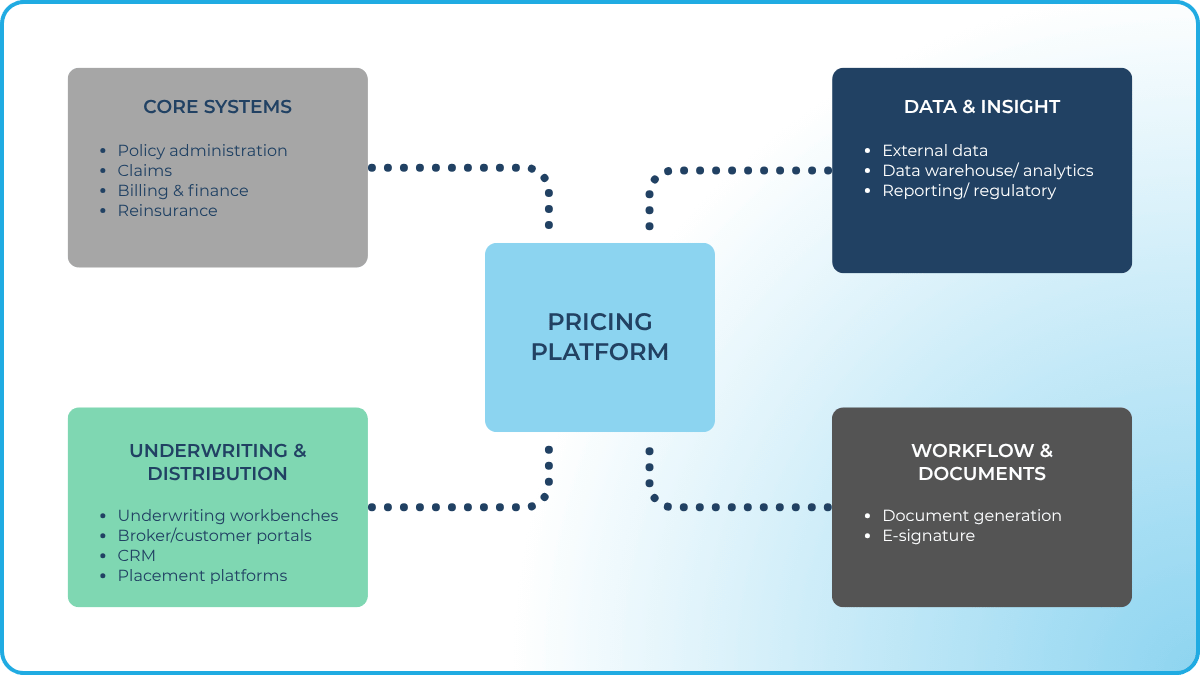
Insurance pricing rarely operates in isolation.
A pricing platform can exchange information with:
- Policy administration systems
- Underwriting workbenches
- Claims systems
- Customer and broker portals
- CRM platforms
- Reinsurance systems
- Data warehouses
- Regulatory reporting platforms
- Document generation systems
Many of these connections have developed gradually through bespoke integrations and customised workflows.
Replacing a pricing engine can therefore affect several parts of the technology estate. This is why the pricing platform itself may represent only one part of a much wider modernisation programme.
Change one piece and you may quickly discover how many other systems depend on it.
Governance has to move with the technology
Insurers need to understand and explain how pricing decisions are made.
That means being able to demonstrate:
- How rates were developed
- Who approved changes
- When those changes became effective
- Which assumptions were used
- Which products were affected
- How pricing requirements and controls were applied
Existing platforms may contain governance processes that have been refined over many years. Actuaries, compliance teams and auditors understand those processes and have confidence in how they operate.
A new pricing environment therefore needs to preserve that control while improving transparency, auditability and the ability to manage change.
Modernisation cannot come at the expense of governance.
The hidden logic inside pricing models
A pricing model that appears relatively straightforward may also contain:
- Product exceptions
- Broker-specific rules
- Regional variations
- Legacy product support
- Underwriting overrides
- Transitional pricing arrangements
- Regulatory exceptions
- Acquisition-specific rules
Some of those decisions may have been made years ago, sometimes by people who are no longer with the organisation.
Documentation can also be incomplete. In these cases, the existing model may have become the most reliable record of how a particular product or risk is priced.
In other words, what looks like an old model may actually contain a lot of hard-won business knowledge.
Understanding that logic is an important first step in modernisation.
Integration is often the harder problem
Pricing is rarely the system of record.
Information may move between several applications before, during and after a quotation. Any change to the pricing environment therefore has to take account of those connections.
Modern APIs make integration considerably easier to build and maintain, but technology alone does not remove organisational dependencies.
Different systems may be owned by different teams, operate on different development cycles and support different business priorities.
A modern pricing platform still has to work within that wider environment.
The API may be straightforward. Getting five teams to change five connected systems at the same time can be rather less so.
People make transformation work
Pricing brings together people with very different requirements.
- Actuaries need modelling flexibility
- Underwriters need speed and usability
- IT teams need maintainability and integration
- Compliance teams need auditability
- Operations teams need stability
A successful modernisation programme has to accommodate all of them.
The technology may work perfectly, but adoption becomes difficult if the people using it do not trust the new processes, controls or outputs.
Building confidence in the new environment is therefore just as important as implementing it.
Modernisation without starting again
Insurance pricing modernisation does not have to mean rebuilding every model or replacing an entire pricing environment at once.
Insurers can modernise incrementally by:
- Separating pricing logic from underlying infrastructure
- Moving existing models into governed platforms
- Exposing pricing models through APIs
- Automating testing and validation
- Improving model version control
- Strengthening governance
- Making model deployment easier to manage
This allows insurers to retain valuable pricing intellectual property while improving the technology and processes around it.
For organisations with substantial investment in Excel, Python, R or other modelling tools, that distinction matters. Modernisation can focus on how models are deployed, integrated, controlled and scaled rather than requiring them to be rebuilt.
As Richard Dixon, Head of London Market Pricing at TMHCCI, said when discussing the digitisation of its pricing models:
“This partnership marks an exciting step forward as we digitise our pricing models to meet the needs of an evolving market.”
That gets to the heart of it. Modernisation does not have to start with throwing away what already works. It can start by making existing pricing expertise easier to deploy and use across the business.
What modern pricing should deliver
A modern pricing environment should make it easier for insurers to change pricing without losing control.
It should enable teams to:
- Develop products faster
- Test pricing strategies safely
- Maintain governance and auditability
- Integrate pricing with enterprise systems
- Support actuarial and underwriting workflows
- Deploy model changes efficiently
- Scale into new products and markets
The objective is not simply to replace old technology with new technology.
It is to remove the constraints that prevent pricing teams from responding quickly while preserving the knowledge and controls the business depends on.
Why legacy systems survive
Legacy pricing systems survive because they do much more than calculate prices.
They hold pricing logic, support established workflows, connect with other systems and preserve years of accumulated knowledge. Replacing them without understanding those dependencies can introduce unnecessary cost, complexity and risk.
So perhaps the better question is not:
“Why haven't insurers replaced their legacy pricing systems?”
It is:
“Which parts of the existing pricing environment are worth preserving, and which parts are holding the business back?”
That provides a much more useful starting point for modernisation.
Because the goal is not to modernise for the sake of it. It is to make pricing easier to change, govern and scale without losing what already works.
Modernise your models without starting again
Optalitix Models enables insurers to deploy, integrate, manage and govern existing pricing models, including Excel, Python and R models, without rebuilding the pricing IP they already trust.
More blogs

From data to decision: how insurers are using underwriter workbenches in 2024
The experience of early adopters has proven that underwriter workbenches can make insurance companies more productive

Concerns Rise Over AI Racial Bias as Facial Recognition “Predicts Criminality”
The debate over racial bias in tech has been renewed as a US university claims it can predict criminality through facial recognition.

How to improve underwriting efficiency through better workflow
How clear workflows improve underwriting efficiency, reduce operational risk and support successful underwriting technology implementation.