
Create a pricing application from a spreadsheet pricing model
When setting a price for a new product, the starting point is almost always Excel. Find out how to create a pricing application from a spreadsheet pricing model here.
Why read this article?
- Do you have a pricing model in a spreadsheet that you want to turn into a cloud-based application (e.g. create a website for clients to access or an API connector for other systems)?
- Have you been told by your system team that it is too time-consuming, or they lack the resources to do it?
If so, this article is for you! Try it out yourself with our interactive example and download the spreadsheet model below.
Summary
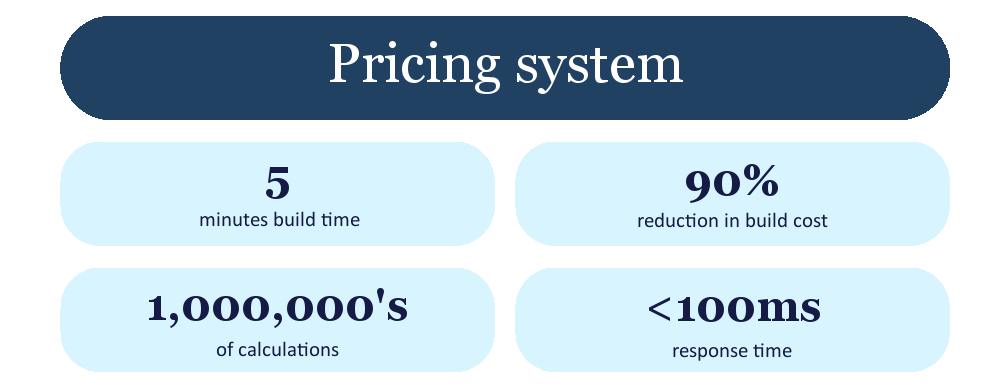
When setting a price for a new project, the starting point is almost always Excel. That is due to Excel's visual interface, the ease of testing and the high number of Excel users who can create these models. Iterating and improving the model in Excel is simple to do, so it allows rapid product deployment. Spreadsheets are a useful tool to create a first pricing model because they are so easy to adapt, and act as a first pass at the final system. However, the problems emerge when these models need to be turned into a system so that lots of clients can get their prices. To convert these spreadsheets into a coded system involves a significant investment. The alternative is they are kept as single-use systems (i.e. only 1 person can get a price at a time) inhibiting sales and product scaling. This is particularly relevant for MGAs looking to scale pricing and underwriting without rebuilding existing models from scratch.Optalitix Models offers a solution to this. Spreadsheets are converted more quickly (in under 5 minutes) into scalable API-driven systems with the Optalitix low-cod solution. Websites can be generated at the click of a button, allowing multiple users to access the pricing.
Benefits to users
The benefits of this approach to building pricing systems are:
- Significant reduction in build time and costs
- Allows Excel developers to create systems.
- Scale pricing models to allow for multiple users
- Remove development bottlenecks
- Protect the intellectual property in your spreadsheets
What to look for when converting an Excel pricing model into an API
Turning an Excel pricing model into a scalable application is about more than simply reproducing the calculations. The right Excel converter or model deployment platform should preserve the logic of the original model while making it easier to test, connect, govern and update.
Key capabilities to look for include:
- Accurate model conversion: Complex formulas, tables and other model logic should be reproduced faithfully without changing the results.
- Testing: Converted models should be easy to test against the original spreadsheet so teams can confirm that outputs remain consistent.
- API and system integration: The model should be able to connect to underwriting, policy administration and other systems through APIs or embedded applications.
- Model governance: Teams should be able to track versions, usage and changes, with a clear record of how the model has evolved.
- Simple model updates: New versions should be easy to test and deploy without rebuilding the surrounding system each time the pricing model changes.
- Monitoring and reporting: Usage and model performance should be visible so teams can understand how deployed models are being used.
Example
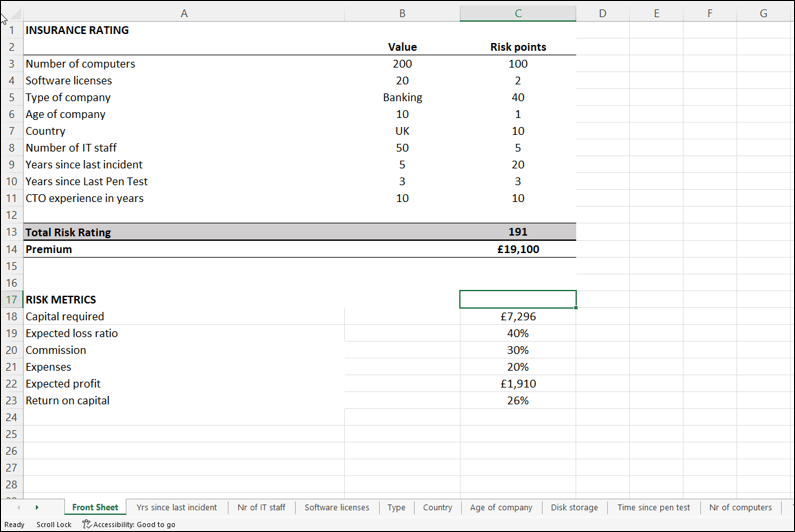
Optalitix created a cyber insurance pricing model that considers key risk factors for a business to determine the risk price to be charged. The model has tables with rating factors in different tabs, as you would expect from a pricing model, but note that the model is purely for demonstration purposes. In addition to the premium, we also wanted to calculate the profit, and capital required, so we could get a view on the profitability and risk involved. This is useful when trying to keep track of the risks taken on, and the underwriting requirements. Here is a link to the example model, shown in the image below.
It takes just 5 minutes to convert this model into a cloud-based Optalitix Model, giving you these valuable benefits:
- Create a customisable webform to embed in your website for customers or brokers to get a price.
- Integrate it with any other system using an API (effectively we have created a micro service/system that can be connected to other systems).
- Track who is using the model and the prices they are quoted.
- Update and change the model as quickly as it was to set up in the first place.
More insights

MGA software: what should MGAs look for in a pricing and underwriting platform
A practical guide to choosing MGA software, covering pricing models, underwriting workflows, referrals, governance, integration and scalability.

After RVS 2026: Where Does Reinsurance Growth Come From?
After RVS 2026, Dani Katz explores where reinsurance growth could come from next, from MGAs and new markets to technology, M&A and shifting capacity

Reinsurance’s Capital Tsunami: Is It Too Much of a Good Thing?
Record capital and falling rates are reshaping reinsurance. What happens when today’s soft market reaches profitability?