

Why is it that in an environment so dependent on the richness of data, the insurance industry still relies on systems that are built simply to transact? Too many insurers claim to deploy modern, cutting edge technology solutions yet their systems are built to process actions without using the valuable insights from their data that can improve the user experience. By building a system that only gets you from point A to point B, existing insurance systems become processing engines that don’t think.
The guesswork is left to their staff and clients using the system, who often make their own subjective decisions as the system provides no insight, despite the volumes of data available to it.These “dumb” systems are no longer going to cut it with the introduction of new InsurTech companies that focus on the customer experience and bring innovations throughout the insurance process, from sales to administration to claims.The question that needs to be asked at the start of a system design is whether those setting up the processes are equipped with the skills needed to ensure that the system “learns” from the customer journey and is capable of using this to improve the process afterwards. In most cases they are not! As a result, the process is not as efficient and effective as it should be.
When setting up these systems, a clear differentiation needs to be made between the “actions” part of the machine and the “brains”. There is a difference between just “doing” and “processing, learning and improving”. The challenge faced by decision makers tasked with implementing machine learning in their processes is identifying developers who can do two things – build a process and enable it to evolve. There are many smart developers who are great at creating task and goal orientated processes, but developers that create systems to analyse, observe and optimise have a completely different skill set – this requires a fusion of data science and technology.For optimum productivity, data will be fed into a decision engine, models will be developed, algorithms will run, whilst simultaneously feeding back fresh insight into the system, suggesting real time changes to the user experience such as new product offerings, personalised incentives, useful marketing messages and improved claims handling. If systems lack inbuilt data science capabilities, insurers will need to bring in external resources to analyse the data, often using (delayed) offline processes and with higher human costs and biases.
This can compromise the customer journey and reduce efficiency. Sales will be lost due to inappropriate focus, claims will be mismanaged due to routing delays and lapse rates increase due to inefficient retention strategies. The actual cost to the insurer ends up being much higher.Decision makers that recognise the need to design systems to learn will shorten the insight loop by appreciating the value that real time business intelligence can add. They benefit from thinking systems as opposed to processing systems.To be competitive, insurers should be asking how smart their systems are, and whether their processes learn and improve over time. If the answer is no, the guessing game will continue.

The Optalitix Round-up: Summer 2024
The second quarter of 2024 has been a hub of activity at Optalitix! Read more now.
.jpeg)
Optalitix Provides Spring Finance with A New Mortgage Origination Platform
Spring Finance have chosen Optalitix, a leader in finance and Insurance software to provide them with a new mortgage origination platform. Read more on our website.

Why Underwriters Matter in Our AI-Driven World
Insurance underwriters still play an important role on the London insurance market despite the increasing use of AI, read more on our website.

Meet Optalitix at MGAA 2024
The Power Of Partnerships - looking at the importance of collaboration and effective communication in driving the future growth

Pool Re partners with Optalitix to implement new treaty and claims management system
Optalitix announces it's partnership with Pool Re, the UK’s largest terrorism reinsurer, to implement a new, end-to-end treaty and claims management system.

Optalitix partners with Go.Compare to offer insurers a new pricing option
Optalitix Quote new pricing platform will get quicker and easier access to onboarding, faster set-up and ready to use quote infrustructure

The Optalitix Round-up: Spring 2024
The first quarter of 2024 has been amazing for us and our clients thanks to us leading groundbreaking developments in our industry. Read more now.

Fix the roof while the sun is still shining (podcast)
Listen to Dani Katz, Co-founder & Director of Optalitix talk about Insurance and Innovation with Matthew Grant

Using insurtech to gain advantage as the market softens
Digital transformation is firmly on the market’s radar, but there is still a long way to go in the underwriting space

Optalitix powers Juniper launch into untapped reproductive health market
Juniper addresses a huge gap in the health insurance market by providing comprehensive health insurance, often excluded by other healthcare products.
Optalitix partners with First Street to enable insurers to incorporate climate risk data into their underwriting
We help insurers incorporate unique datasets into their underwriting process, thereby ensuring quotes are appropriately priced in response to a changing climate.
From data to decision: how insurers are using underwriter workbenches in 2024
The experience of early adopters has proven that underwriter workbenches can make insurance companies more productive
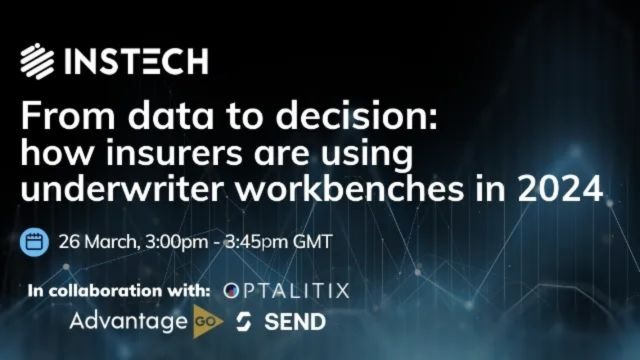
Join Optalitix for an InsTech webinar on how insurers are using underwriting workbenches
We are excited to be taking part in a thought-provoking InsTech webinar on 26th March

Meet Optalitix at Insurtech Insights EU 2024
The Insurech Conference connects insurers and investors, offering an unparalleled experience and access to industry innovators. Explore 2024 Conference insights!

Meet Optalitix at BIBA 2024
Explore ‘What’s next?’ in the insurance industry, and connect with brokers and others from the industry.