

Listening to the government’s health and science advisors on television this week, has been somewhat frightening. The world does not have the answer to its biggest problem, in fact our smartest minds are at a bit of a loss. There is no settled science that can accurately predict an outcome, there is no experience to draw on and no sign of a solution.
What we have heard a lot of this last few weeks, is modelling, curves and the power of models to efficiently determine an outcome or at the very least predict an outcome. Acknowledging the fact that the greatest human minds are doing their very best to address the pending scale of this crises without much success is it any surprise that AI or non - human solutions are being used to model potential outcomes and solutions.
In the actuarial world under the circumstances a data scientist will look to create a model that will help plan a route forward, how would they do this?What is going on? Have we seen anything like this before? Has something similar previously been experienced we can learn from? These would be the initial thoughts of anyone wishing to create a model. Replicating a similar scenario would be the starting point of anyone wishing to begin a modelling exercise.
We know we have a disease that is spreading by contact, have we seen something that may not be exactly the same but similar such as perhaps HIV that could be used to begin the modelling process.
- Without actuals we need to start setting the assumptions
One of the assumptions might be, the Rate of transmission, scientists would call this the R rate, or number of potential cases or people that could get infected. This R rate is one of the most if not most complex variables impacting on the modelling especially over longer periods.
- Looking backwards to look forwards
What limited information is available about the spread of the disease is used to predict the most accurate possible outcomes.
- Giving the model a second look!
With the technical elements of any model construction undertaken and with the luxury of live data now being available scientists can check whether the curve is tracking as predicted and whether or not there is a need for agility and flexibility. It is at this period where analysts can adjust for different interventions which may be required or undertaken.
- Is it right to be wrong?
Remembering we are in unknown territory and being aware that the current experience is unique we need to factor in uncertainty and the possibility of error. Working with limited data to predict a larger panacea will require wriggle room, sometimes considerable wriggle room!
- Staying positive and flexibly optimistic
As a society it is important to look for areas of optimism as this will fuel energy and enthusiasm in the model and ensure that scientists look to similar scenarios for adaption and agility. Understanding that lock downs, social distance, research, vaccines and the growing volume of knowledge from around the world will allow for positive alteration of the model and ultimately squash that curve.
Through all of this what strikes the author most is the sheer degree of dependency the UK has had on non-medical knowledge. We went from a society obsessed with Brexit and being experts on the back stop to being actuarily accomplished and understanding how to flatten the curve or squash the sombrero. We got to experience first-hand how important it is to adapt to a constantly changing environment that will pump fresh information into the model. Of even greater value to predictive science is our appetite to accept that the model will govern our behavior, and any changes that may be required in said behavior.
What the author is not saying is that medical scientists should be discounted, on the contrary it is the data and expertise generated by these experts that will feed the model, it is their experience and dedication on the front line that will prove the model but it is actuaries and data scientists who will build, monitor and adjust the model.
Alistair King
How to get underwriting efficiency. Workflow and the underwriting workbench
Improve underwriting efficiency with Optalitix's workflow and workbench expertise. Our tools handle various processes, quotes, and large underwriting departments.
A practical guide to underwriting workbenches
Explore how our underwriting workbench aids insurers in handling incoming risks, monitoring their risk profile, and aligning management with their risk appetite.
Optalitix celebrates 10 years!
Optalitix products now available on Google Cloud Marketplace
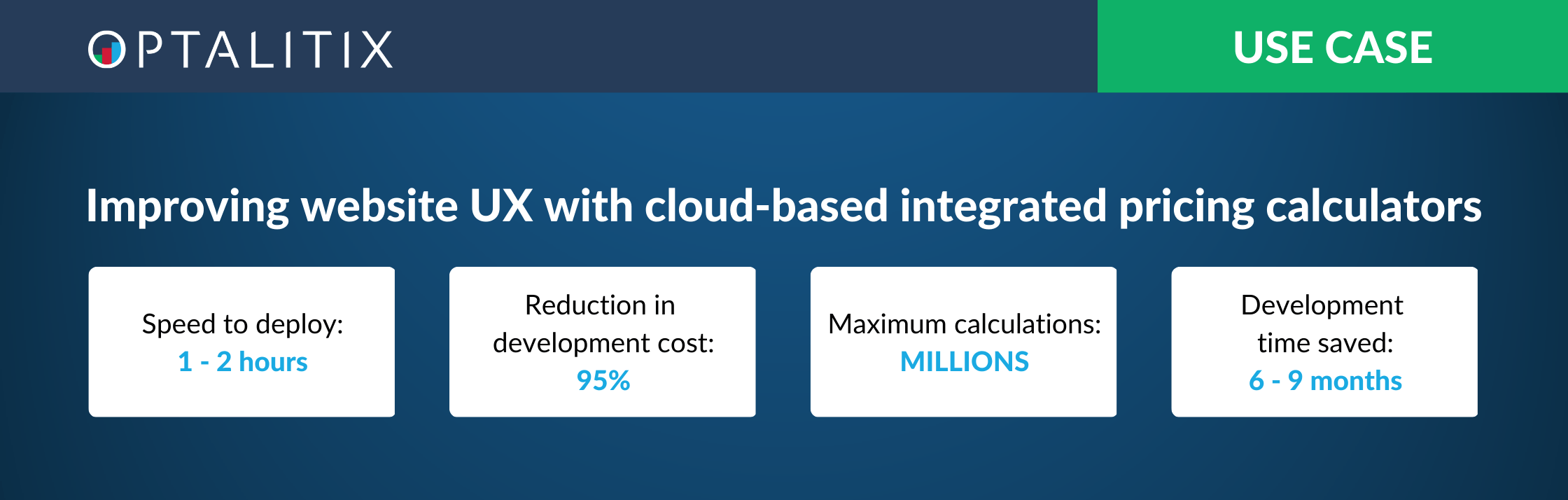
Onespark use case: Improving website UX with cloud-based integrated pricing calculators
Building a pricing calculator into a CRM for Almagro Capital
Almagro wanted a calculator for their products to be built into the Zoho CRM system. Find out how Optalitix Models connected the Almagro CRM system in Zoho here.
Meet Optalitix at Insurtech Insights EU 2023
The Insurech Conference connects insurers and investors, offering an unparalleled experience and access to industry innovators. Explore 2023 Conference insights!
Optalitix appoints Paul Hewitt to their Board following the investment into Optalitix by 24Haymarket
Paul Hewitt has been appointed to the Board of Optalitix, advising on insurance strategy, product development and industry partnerships. Read more in this guide.
.jpeg)
Building a pricing system from a spreadsheet
Have you got an Excel pricing model that you would love to turn into a system? Find out how to build a pricing system from a spreadsheet in our guide.
Optalitix & Avamore launching new lending platform using Optalitix Originate
Optalitix Client Avamore will be launching its new core lending platform using Optalitix Originate architecture. Read more about the platform and its targets.
Optalitix Models integrates easily with Retool to create no-code apps from spreadsheets
Spreadsheet-based calculations representing real-world situations are referred to a models. See how to convert yours into usable application software here.
Optalitix announces that it has achieved the prestigious ISO 27001 certification
OOptalitix announced it has achieved the prestigious ISO 27001 certification by implementing an Information Security Management System (ISMS). Read more here
New pricing standards at Lloyd's require improvements in underwriting systems
New principles for doing business at Lloyd’s will encourage syndicates to digitise their processes, especially underwriting. Find out more here.
Learn about insurance innovation from the DIA conference
The Dia Munich Conference, in 2022, showcased cutting-edge insurance technology, highlighting the growing fusion of insurance and technology in mainland Europe.
Optalitix raises £4m of funding for growth
Optalitix is an award-winning technology business that adds value to financial institutions with low code SaaS products, data analysis and AI models. Read more.