
In the dynamic landscape of the insurance industry, one might wonder why insurers seem to be engaged in a guessing game. As risk factors evolve, customer expectations shift, and global uncertainties persist, insurers find themselves grappling with challenges that require them to make informed decisions. Too many insurers claim to deploy modern, cutting-edge technology solutions yet their systems are built to process actions without using the valuable insights that can improve the user experience.
One of the key factors contributing to the perceived guessing game is the complexity of risk assessment. Insurers operate in an environment where risks are multifaceted and continually changing. From natural disasters and economic fluctuations to emerging technologies and evolving customer behaviours, insurers must navigate a myriad of variables to accurately assess and underwrite risks.
The guesswork is left to the staff using the system, who often make their own subjective decisions as the system provides no insight, despite the volumes of data available to it.
The question that needs to be asked at the start of a system design is whether those setting up the processes are equipped with the skills needed to ensure that the system “learns” from the current customer journey and is capable of learning from the process afterwards. In most cases, they are not! As a result, the process is not as efficient and effective as it should be.
It is not always obvious to those setting up these systems that a clear differentiation needs to be made between the “actions” part of the machine and the “brains”. There is a difference between just “doing” and “processing, learning improving”.
The challenge faced by decision-makers tasked with implementing machine learning in their processes is identifying developers who can do two things –build a process and enable it to evolve. Many smart developers are great at creating task and goal-orientated processes, but developers who create systems to analyse, observe and optimise have a completely different skill set – this requires a fusion of data science and technology.
For optimum productivity, data will be fed into a decision engine, models will be developed, and algorithms will run, whilst simultaneously feeding back fresh insight into the system, suggesting real-time changes to the use experience such as new product offerings, personalised incentives, useful marketing messages and improved claims handling.
If systems lack inbuilt data science capabilities, insurers will need to bring in external resources to analyse the data, often using (delayed) offline processes and with higher human costs and biases.
This can compromise the customer journey and reduce efficiency. Sales will be lost due to inappropriate focus, claims will be mismanaged due to routing delays and lapse rates increase due to inefficient retention strategies. The actual cost to the insurer ends up being much higher.
Decision makers who recognise the need to design systems to learn will shorten the insight loop by appreciating the value that real-time business intelligence can add. They benefit from thinking systems as opposed to processing systems. Furthermore, insurers are increasingly integrating data analytics and machine learning into their operations to enhance risk assessment. While these technologies hold great promise, their deployment is not without its challenges.
In the ever-evolving landscape of the insurance industry, the perception that insurers are playing a guessing game is rooted in the inherent complexities they face. To be competitive, insurers should be asking how smart their systems are, and whether their processes learn and improve over time. If the answer is “not really”, the guessing game will continue.
How to get underwriting efficiency. Workflow and the underwriting workbench
Improve underwriting efficiency with Optalitix's workflow and workbench expertise. Our tools handle various processes, quotes, and large underwriting departments.

A practical guide to underwriting workbenches
Explore how our underwriting workbench aids insurers in handling incoming risks, monitoring their risk profile, and aligning management with their risk appetite.
Optalitix celebrates 10 years!
Optalitix products now available on Google Cloud Marketplace
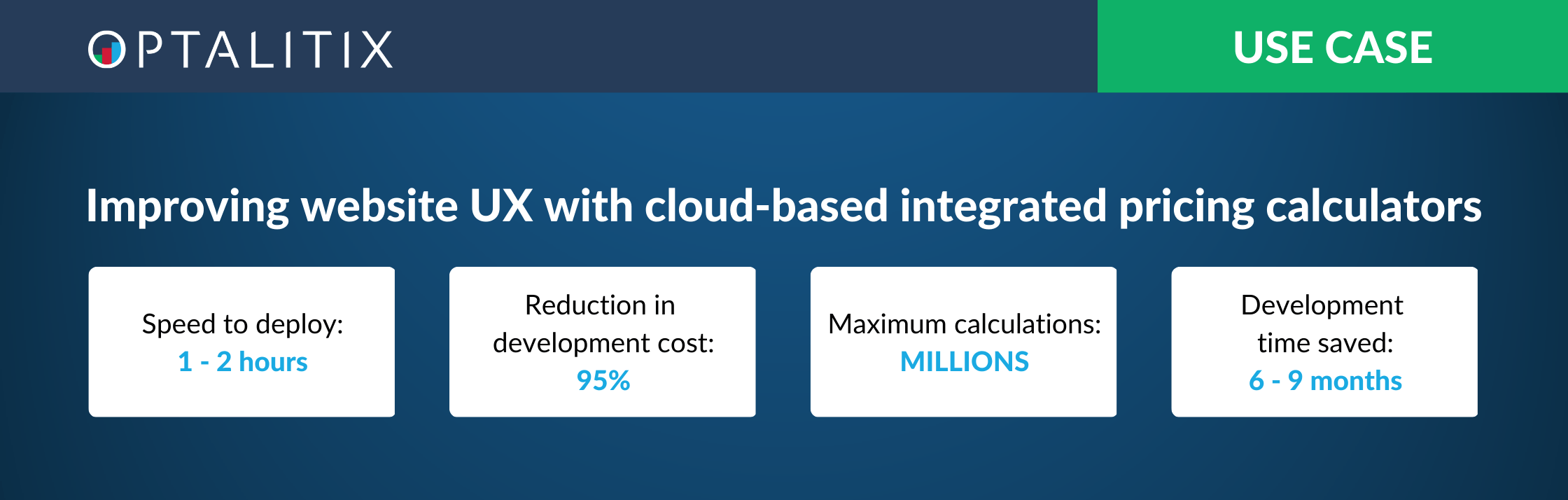
Onespark use case: Improving website UX with cloud-based integrated pricing calculators
Building a pricing calculator into a CRM for Almagro Capital
Almagro wanted a calculator for their products to be built into the Zoho CRM system. Find out how Optalitix Models connected the Almagro CRM system in Zoho here.
Meet Optalitix at Insurtech Insights EU 2023
The Insurech Conference connects insurers and investors, offering an unparalleled experience and access to industry innovators. Explore 2023 Conference insights!
Optalitix appoints Paul Hewitt to their Board following the investment into Optalitix by 24Haymarket
Paul Hewitt has been appointed to the Board of Optalitix, advising on insurance strategy, product development and industry partnerships. Read more in this guide.
.jpeg)
Building a pricing system from a spreadsheet
Have you got an Excel pricing model that you would love to turn into a system? Find out how to build a pricing system from a spreadsheet in our guide.
Optalitix & Avamore launching new lending platform using Optalitix Originate
Optalitix Client Avamore will be launching its new core lending platform using Optalitix Originate architecture. Read more about the platform and its targets.
Optalitix Models integrates easily with Retool to create no-code apps from spreadsheets
Spreadsheet-based calculations representing real-world situations are referred to a models. See how to convert yours into usable application software here.
Optalitix announces that it has achieved the prestigious ISO 27001 certification
OOptalitix announced it has achieved the prestigious ISO 27001 certification by implementing an Information Security Management System (ISMS). Read more here
New pricing standards at Lloyd's require improvements in underwriting systems
New principles for doing business at Lloyd’s will encourage syndicates to digitise their processes, especially underwriting. Find out more here.
Learn about insurance innovation from the DIA conference
The Dia Munich Conference, in 2022, showcased cutting-edge insurance technology, highlighting the growing fusion of insurance and technology in mainland Europe.
Optalitix raises £4m of funding for growth
Optalitix is an award-winning technology business that adds value to financial institutions with low code SaaS products, data analysis and AI models. Read more.