

The Monte Carlo Rendezvous 2025 once again delivered energy and optimism, but also divergent thinking on whether to invest into the sector or hunker down and wait out the next cycle.
The debate at this year’s event felt particularly dynamic, not just because of the strong results reported across the insurance market, but because of the anticipation of what is to come. The question on many minds: reinsurers, insurers and brokers alike was this: where is the smart money going in reinsurance today?
A hard market
It’s hard to ignore the strength of current market performance. Gallagher puts the average combined loss ratio at 87.5%, the second-best H1 ratio since records began and possibly only bettered in 2013.
Lloyds recently posted profits of £4.2 billion for H1 2025. The underwriting result was down, but on the previously exceptional year. Lloyds also posted a 6% increase in top-line growth, and the underlying financial health across many carriers remains strong.
Even against a backdrop of claims events such as the LA wildfires, profitability has remained resilient. As Gallagher also highlighted, returns on equity have reached 17.7%, well above the average cost of capital. From a performance perspective, reinsurers are experiencing a very good year indeed with the current figures among the best in recent memory.
The absence of major windstorm activity has made a significant contribution to the numbers. For the moment, the oceans are calm with no major territories hit by significant wind events. If this continues,2025 could go down as an outstanding year for reinsurance cat business.
Returns of this magnitude are hard to ignore and, unsurprisingly, capital is looking to come in.
Heightened M&A activity signals market confidence and growing competition
This performance in a sector that is counter-cyclical has triggered a sharp increase in M&A activity, as new entrants and private capital look for a more aggressive foothold in a strongly profitable market. Recent transactions are a clear indication of this momentum, and external investor interest was a new feature of the RVS scene.
In July, Atrium Underwriting announced its acquisition by CRC Group, with completion expected in Q3. In August, Sompo International made headlines with its $3.5 billion purchase of Aspen—one of the most significant reinsurance deals of the year. Also in July, Enstar was acquired by private equity firm Sixth Street in a $5.1 billion transaction.
This kind of deal-making is not coincidental. Investors are looking at the current returns and seeing opportunity.
A widening gap between new and old capital
However, this investment and the perception of where the market’s profitability are not all heading in the same direction. Overall capital in the sector has grown to $720bn, so clearly more money is coming in than going out.
What was clear in Monte Carlo is the growing divergence between the perspectives of seasoned reinsurers, predicting a softer cycle in the future, and those of newer or external capital who are forecasting high returns. While alternative capital continues to flood in—particularly via index-linked securities and other vehicles that allow carriers to expand their cat capacity—a number of established players are applying the brakes.
One CEO I spoke with during the Rendezvous summed it up well. His company was actively reducing GWP expectations by 30%, with the goal of only writing the most disciplined, well-rated risks. His concern was that much of the business now available in the market will not be priced adequately for the risk it carries. He isn’t alone in this sentiment.
In contrast, new capital appears focused on capturing market share while the sector still offers attractive returns. The logic is understandable - returns are currently strong, and many see now as the time to push for top-line growth.
But for those who’ve lived through multiple cycles, there is a sense of caution. They’ve seen how quickly the market can turn and believe we’re approaching that inflection point. For them, this is not the time to chase volume, but rather to focus on sustainable underwriting discipline.
Rates softening and terms shifting
That divergence of strategy is already having consequences. With capital chasing growth, clients are being presented with more coverage options than they’ve seen in years. Rates are beginning to soften and the market is already seeing changes in the terms of cover being requested.
Reinstatement premiums, which had previously been removed, are being brought back in. Clients are seeking lower excess points to cover higher-frequency events, not just catastrophic ones. Even historically excluded risks—such as certain Florida properties—are being pushed back into cover. It’s clear that the market is softening, and fast.
What’s perhaps most concerning is how quickly the landscape could shift. At the conference, there was a general acceptance that rates will come down. But the hope is that this softening happens in a controlled and orderly manner. The industry is keen to avoid a disorderly reversal of the rate increases in 2022. Reinsurers are starting their renewals from a strong, profitable premium base. The goal now is to manage the decline in a way that preserves profitability and underwriting discipline and avoids giving back hard-earned margin in a single cycle.
1/1 renewals - is a buyer’s market emerging?
The signs suggest that the 1/1 renewals will be particularly challenging. With an increasing volume of capital chasing the same business, the dynamic is shifting to a buyer’s market. Guy Carpenter shared a similar perspective, noting that reinsurers are already seeing pressure on pricing and terms, and that securing renewals without significant compromise will be a challenge.
In my view, the smart underwriting money is not chasing the top line. Instead, it’s holding back and focusing on sustainable returns, prudent underwriting and preserving capital. But in doing so, it risks losing market share to competitors who are willing to undercut on price. That tension will be one of the defining features of the next renewal cycle.
Systems must step up to create more ground-level visibility
As the market begins to transition, many risk carriers are realising they do not have clarity into what’s happening on the ground. With more pressure on individual underwriters to secure renewals, there is growing concern about what rate discounts are being offered, the improved terms being offered and the resulting risks they are being exposed to. In many firms, the gap between strategic underwriting goals and what’s happening in day-to-day decision-making is beginning to widen.
The role of AI – still early, but making an impact coming
Artificial intelligence continues to come up in conversations, especially with regard to improving processes, though I believe it’s still early days for AI to materially impact reinsurance decisions. That said, the direction of travel is clear. Automation, data-driven underwriting intelligent portfolio management are all going to be central to howsuccessful reinsurers operate in the coming years.
So, where is the smart money heading?
So, which money is making the smart moves? Are the winners the investors who are aggressively entering the market, taking advantage of current pricing to grow their footprint? Or is the real intelligence in restraint—contracting, being selective and preparing for a turn in the cycle?
There is no correct answer at this stage. But what’s clear is that data, discipline and insight will separate those who succeed in this next phase from those who fall into the trap of chasing short-term growth at the expense of long-term value. These insights require companies to have digital processes – to collect the data, and be able to benefit from emerging technologies like AI.

How to get underwriting efficiency. Workflow and the underwriting workbench
Improve underwriting efficiency with Optalitix's workflow and workbench expertise. Our tools handle various processes, quotes, and large underwriting departments.

A practical guide to underwriting workbenches
Explore how our underwriting workbench aids insurers in handling incoming risks, monitoring their risk profile, and aligning management with their risk appetite.
Optalitix celebrates 10 years!
Optalitix products now available on Google Cloud Marketplace
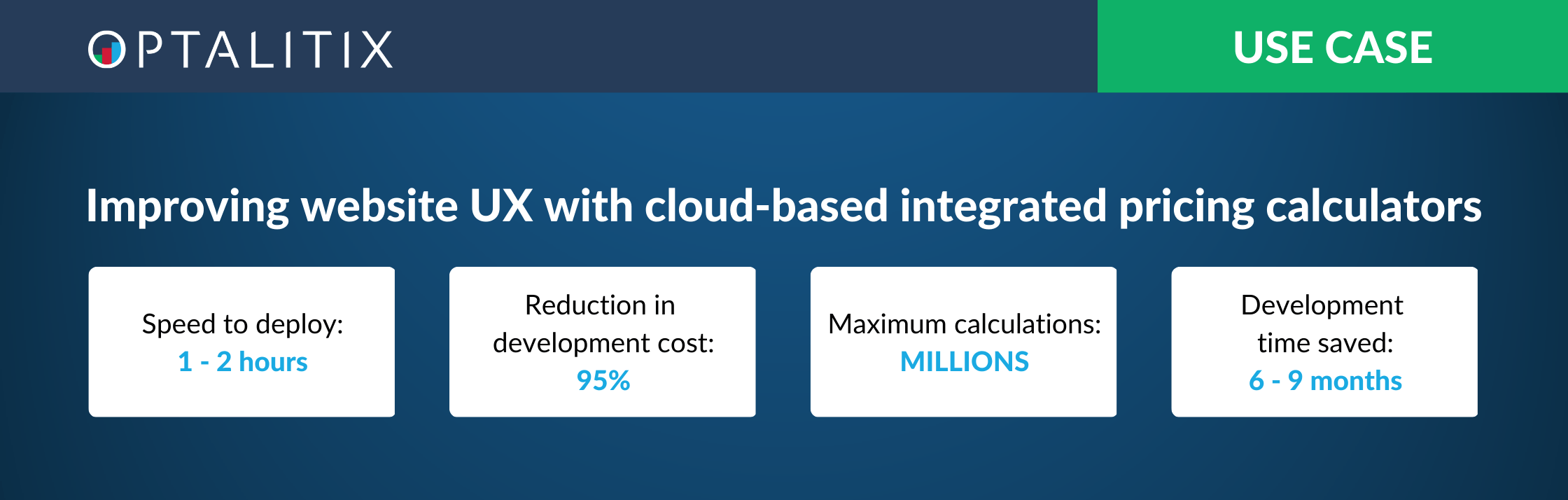
Onespark use case: Improving website UX with cloud-based integrated pricing calculators
Building a pricing calculator into a CRM for Almagro Capital
Almagro wanted a calculator for their products to be built into the Zoho CRM system. Find out how Optalitix Models connected the Almagro CRM system in Zoho here.
Meet Optalitix at Insurtech Insights EU 2023
The Insurech Conference connects insurers and investors, offering an unparalleled experience and access to industry innovators. Explore 2023 Conference insights!
Optalitix appoints Paul Hewitt to their Board following the investment into Optalitix by 24Haymarket
Paul Hewitt has been appointed to the Board of Optalitix, advising on insurance strategy, product development and industry partnerships. Read more in this guide.
.jpeg)
Building a pricing system from a spreadsheet
Have you got an Excel pricing model that you would love to turn into a system? Find out how to build a pricing system from a spreadsheet in our guide.
Optalitix & Avamore launching new lending platform using Optalitix Originate
Optalitix Client Avamore will be launching its new core lending platform using Optalitix Originate architecture. Read more about the platform and its targets.
Optalitix Models integrates easily with Retool to create no-code apps from spreadsheets
Spreadsheet-based calculations representing real-world situations are referred to a models. See how to convert yours into usable application software here.
Optalitix announces that it has achieved the prestigious ISO 27001 certification
OOptalitix announced it has achieved the prestigious ISO 27001 certification by implementing an Information Security Management System (ISMS). Read more here
New pricing standards at Lloyd's require improvements in underwriting systems
New principles for doing business at Lloyd’s will encourage syndicates to digitise their processes, especially underwriting. Find out more here.
Learn about insurance innovation from the DIA conference
The Dia Munich Conference, in 2022, showcased cutting-edge insurance technology, highlighting the growing fusion of insurance and technology in mainland Europe.
Optalitix raises £4m of funding for growth
Optalitix is an award-winning technology business that adds value to financial institutions with low code SaaS products, data analysis and AI models. Read more.