

Globally, the AI industry and the techniques it produces are expected to generate up to $5 trillion dollars in value, according to estimates from a McKinsey Global Institute (MGI) report. Given the major advantages of the increased usage of Artificial Intelligence can bring, it should come as no surprise that AI has been valued so highly.
Why is the AI industry worth so much?
As previously mentioned, the AI industry brings major benefits to a wide range of organisations, including huge economic advantages.
This is because AI allows for significant gains in performance and efficiency in many different industry sectors. AI techniques can also analyse, process, and learn this information at a much faster speed than humans, and with far greater accuracy.
In addition, Artificial Intelligence can be easily integrated into existing processes. That means the AI solution can ultimately reduce costs as it makes more accurate decisions through the improved use of information.
Examples of Artificial Intelligence already in use include designing video games that act more lifelike and in a completely different way. Other ways that AI is being used in insurance to better learn the risk of underwriting and claims, in finance to better understand risk and trends and even video conferencing to offer recommendations based on behaviour of participants.
We can also see applied AI being used across business practices in law, medicine, accounting, consulting, customer service and management.
How much is the AI industry worth in the UK?
The Artificial Intelligence industry in the UK has the potential to be worth a staggering amount. Estimates suggest that AI solutions could add a whopping £630bn to the UK economy by 2035.
Unsurprisingly, this means that a number of businesses are developing in order to meet demand. According to recent data, there are at the very least, 200 startups and small and medium-sized businesses developing products using AI in the UK.
Why does AI matter?
One of the major reasons that artificial intelligence matters is due to the enormous potential it has for increasing productivity at an exponential rate. This is particularly important for the UK economy, and for sectors that are feeling the strain of limited resources.
For example, a government report called 'Growing the Artificial Intelligence Industry in the UK' has outlined some of the areas with the capability of changing sectors to become far more efficient.
This includes health care. Areas that have been highlighted as having AI software potential include:
- Radiology and pathology via the use of imagining diagnostics
- Better tracking of possible pandemics
- Diagnostics to detect small variations in baseline health data of a patient, providing a more personalised treatment option
Another area that benefits dramatically from AI is the automotive sector. For example, autonomous maintenance of vehicles, saving time and money, or autonomous fleets, which would mean people could use the vehicle on an ad hoc basis without needing to own a car or having onerous paperwork to take care of.
It has also been discussed using AI to help improve overall efficiency in public sector services in the UK. For example, to process passports, visas, benefits and other licences processed by the government. AI enables these to be processed at a faster rate and with greater accuracy.
How to get underwriting efficiency. Workflow and the underwriting workbench
Improve underwriting efficiency with Optalitix's workflow and workbench expertise. Our tools handle various processes, quotes, and large underwriting departments.

A practical guide to underwriting workbenches
Explore how our underwriting workbench aids insurers in handling incoming risks, monitoring their risk profile, and aligning management with their risk appetite.
Optalitix celebrates 10 years!
Optalitix products now available on Google Cloud Marketplace
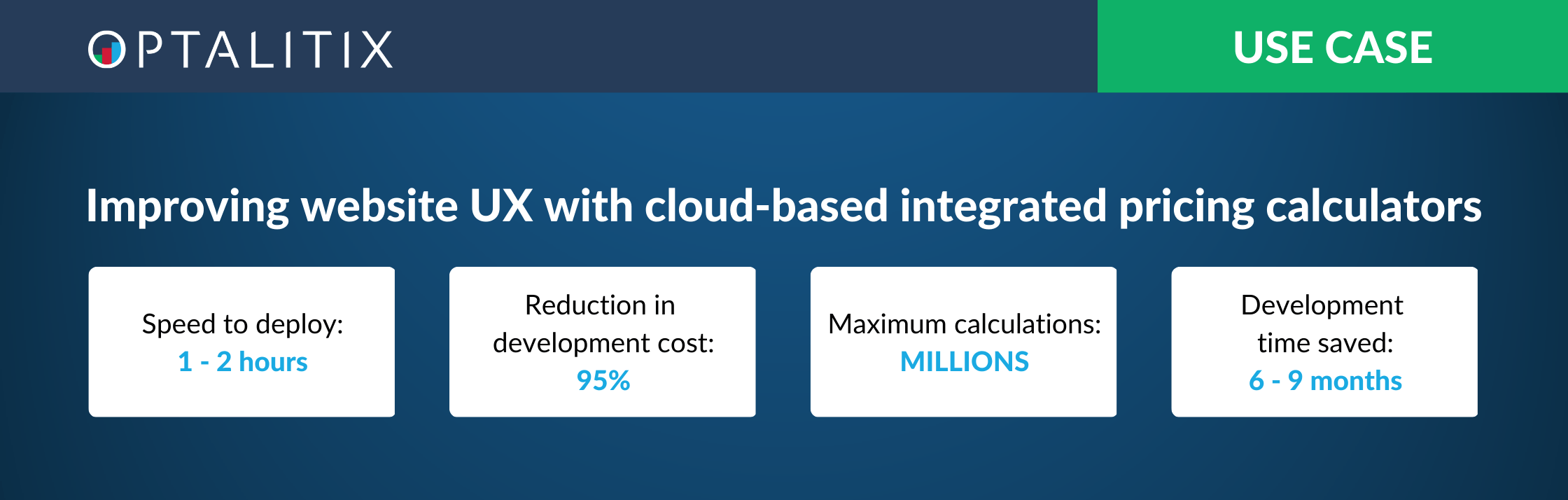
Onespark use case: Improving website UX with cloud-based integrated pricing calculators
Building a pricing calculator into a CRM for Almagro Capital
Almagro wanted a calculator for their products to be built into the Zoho CRM system. Find out how Optalitix Models connected the Almagro CRM system in Zoho here.
Meet Optalitix at Insurtech Insights EU 2023
The Insurech Conference connects insurers and investors, offering an unparalleled experience and access to industry innovators. Explore 2023 Conference insights!
Optalitix appoints Paul Hewitt to their Board following the investment into Optalitix by 24Haymarket
Paul Hewitt has been appointed to the Board of Optalitix, advising on insurance strategy, product development and industry partnerships. Read more in this guide.
.jpeg)
Building a pricing system from a spreadsheet
Have you got an Excel pricing model that you would love to turn into a system? Find out how to build a pricing system from a spreadsheet in our guide.
Optalitix & Avamore launching new lending platform using Optalitix Originate
Optalitix Client Avamore will be launching its new core lending platform using Optalitix Originate architecture. Read more about the platform and its targets.
Optalitix Models integrates easily with Retool to create no-code apps from spreadsheets
Spreadsheet-based calculations representing real-world situations are referred to a models. See how to convert yours into usable application software here.
Optalitix announces that it has achieved the prestigious ISO 27001 certification
OOptalitix announced it has achieved the prestigious ISO 27001 certification by implementing an Information Security Management System (ISMS). Read more here
New pricing standards at Lloyd's require improvements in underwriting systems
New principles for doing business at Lloyd’s will encourage syndicates to digitise their processes, especially underwriting. Find out more here.
Learn about insurance innovation from the DIA conference
The Dia Munich Conference, in 2022, showcased cutting-edge insurance technology, highlighting the growing fusion of insurance and technology in mainland Europe.
Optalitix raises £4m of funding for growth
Optalitix is an award-winning technology business that adds value to financial institutions with low code SaaS products, data analysis and AI models. Read more.