

In his 1962 State of the Union Address, John F. Kennedy declared: “The best time to repair the roof is when the sun is shining.” These words of wisdom still ring true today, as was recently highlighted by our co-founder, Dani Katz, who said: “Now is the right time for insurance companies to upgrade their technology, before soft market conditions really return and pricing competition heats up.”
This said, pricing competition may be with us sooner than some thought. While John Neal recently reported Lloyd’s best underwriting performance since 2007, and predicted several more years of high premiums, it now seems his forecast may be overly optimistic. For instance, global broker Marsh recently reported that Insurance pricing continues to moderate with rates declining in the majority of regions, and some business lines, such as Cyber and D&O, already softening. It’s time to prepare for the next soft market.
Indeed, in one recent industry headline, insurance CFOs across Europe are already warning that price competition is back. These are the findings of Moody’s latest annual survey of insurance CFO sentiment, which show that CFOs’ three primary concerns for 2024 are sluggish economic growth, financial market volatility, and competitive pressure.
Hard markets inevitably draw in more capacity, at some stage, and we have already seen four new players enter the Lloyd’s Market this year. As competition increases pricing will start to fall as firms have to compete more aggressively to retain or win new business.
It might not be raining yet, but there are definitely some dark clouds on the horizon.
When’s the second best time to fix the roof?
I mention this because, while it looks like true digital transformation in insurance is still some way off, there are clear signs things are moving. Lloyd’s Blueprint 2 and CDR initiatives are not there yet, but they are heading in the right direction ,after so many false starts in the market.
Digital transformation is now firmly on the market’s radar, yet we still have a long way to go in the underwriting space. Currently, most underwriting is still done using Excel spreadsheets. According to research from Milliman, 61% of actuaries say that they use spread sheets extensively, while 67% say they are critically important to their work.
This said, there are insurance firms that have been moving with the times, with spreadsheets going to the cloud using converting software. This brings several important advantages, not least the ability to faithfully convert the exact model calculations from the original spreadsheet.
Insurers using this type of software are also able to test the converted spreadsheets to verify that the produce the exact same results as the original spreadsheet.
Crucially, the right software also creates converted spreadsheet models that can connect to all the other systems involved in the pricing process. This connection can be via an API, a hosted web environment that can be embedded on a client’s website, or a custom integration with the underlying quote or policy administration system.
Connecting with other systems in this way offers the chance to embed spreadsheets into core cloud infrastructures, making them scalable, stable, and secure.
In fact, this is close to a shortcut to building cloud-based infrastructures for underwriting and pricing. Most of all though, embedding spreadsheets in the cloud makes that data available to other systems, allowing it to be used in other applications. That’s the step which will completely transform our industry.
A new technology whose time has come
Another underwriting and pricing technology that’s getting a lot of attention in the market right now is underwriting workbenches. Every insurer know has a project underway to look into underwriting workbenches, which are centralised platforms where underwriters can access all the digital tools,data, and insights they need to take them through the whole underwriting process from submission to binding.
It’s no wonder they’re proving so popular, since these workbenches offer both improved risk management and reduced loss rations. At the same time,insurers are finding that workbenches enhance workflow management and provide compliance assurance and navigational guidance through the constantly evolvingregulatory landscape, helping to ensure that the underwriting process aligns with current regulations.
Early adopters are winning
In a recent PwC survey Andy Moore, PwC,Partner said, “London’s continued success as a global insurance hub depends on successful digital transformation.” The majority of insurers agree, with 54% of respondents in the survey saying their current workbench or workflow tools were unfit for purpose.
Yet, one in five respondents in that same survey claimed their new digital workbenches are fit for purpose. These early adopters of digital transformation are already seeing excellent results, from doubling productivity to scaling rapidly and improving underwriting profitability.
So, while some insurers are making big profits and resting on their laurels, other arepreparing for battle in advance, with a market softening surely coming. If you’re not fully digitalised and in the cloud when pricing competition returns, your competitors are going to win. Now is the time to repair your roof, and digitalise, before the clouds build and the storms return.
Hard markets inevitably draw in more capacity, at some stage, and we have already seen four new players enter the Lloyd’s Market this year. As competition increases pricing will start to fall as firms have to compete more aggressively to retain or win new business.
It might not be raining yet, but there are definitely some dark clouds on the horizon.
When’s the second best time to fix the roof?
I mention this because, while it looks like true digital transformation in insurance is still some way off, there are clear signs things are moving. Lloyd’s Blueprint 2 and CDR initiatives are not there yet, but they are heading in the right direction, after so many false starts in the market.
Digital transformation is now firmly on the market’s radar, yet we still have a long way to go in the underwriting space. Currently, most underwriting is still done using Excel spreadsheets. According to research from Milliman, 61% of actuaries say that they uses spreadsheets extensively, while 67% say they are critically important to theirwork.
This said, there are insurance firms that have been moving with the times, with spreadsheets going to the cloud using converting software. This brings several important advantages, not least the ability to faithfully convert the exact model calculations from the original spreadsheet.
Insurers using this type of software are also able to test the converted spreadsheets to verify that the produce the exact same results as the original spreadsheet.
Crucially, the right software also creates converted spreadsheet models that can connect to all the other systems involved in the pricing process. This connection can be via an API, a hosted web environment that can be embedded on a client’s website, or a custom integration with the underlying quote or policy administration system.
Connecting with other systems in this way offers the chance to embed spreadsheets into core cloud infrastructures, making them scalable, stable, and secure.
In fact, this is close to a shortcut to building cloud-based infrastructures for underwriting and pricing. Most of all though, embedding spreadsheets in the cloud makes that data available to other systems, allowing it to be used in other applications. That’s the step which will completely transform our industry.
A nontechnology whose time has come
Another underwriting and pricing technology that’s getting a lot of attention in the market right now is underwriting workbenches. Every insurer Iknow has a project underway to look into underwriting workbenches, which are centralised platforms where underwriters can access all the digital tools,data, and insights they need to take them through the whole underwriting process from submission to binding.
It’s no wonder they’re proving so popular, since these workbenches offer both improved risk management and reduced loss rations. At the same time, insurers are finding that workbenches enhance workflow management and provide compliance assurance and navigational guidance through the constantly evolving regulatory landscape, helping to ensure that the underwriting process aligns with current regulations.
Early adopters are winning
In a recent PwC survey Andy Moore, PwC,Partner said, “London’s continued success as a global insurance hub depends on successful digital transformation.” The majority of insurers agree, with 54% of respondents in the survey saying their current workbench or workflow tools were unfit for purpose.
Yet, one in five respondents in that same survey claimed their new digital workbenches are fit for purpose. These early adopters of digital transformation are already seeing excellent results, from doubling productivity to scaling rapidly and improving underwriting profitability.
So, while some insurers are making big profits and resting on their laurels, other are preparing for battle in advance, with a market softening surely coming. If you’re not fully digitalised and in the cloud when pricing competition returns, your competitors are going to win. Now is the time to repair your roof, and digitalise, before the clouds build and the storms return.
How to get underwriting efficiency. Workflow and the underwriting workbench
Improve underwriting efficiency with Optalitix's workflow and workbench expertise. Our tools handle various processes, quotes, and large underwriting departments.

A practical guide to underwriting workbenches
Explore how our underwriting workbench aids insurers in handling incoming risks, monitoring their risk profile, and aligning management with their risk appetite.
Optalitix celebrates 10 years!
Optalitix products now available on Google Cloud Marketplace
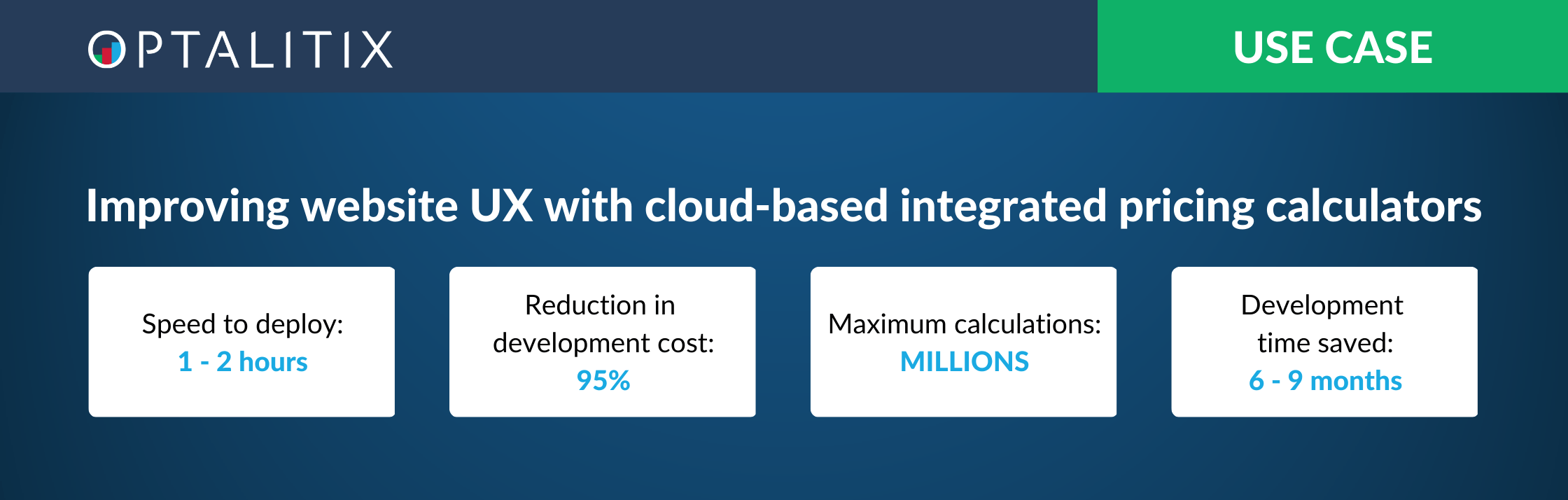
Onespark use case: Improving website UX with cloud-based integrated pricing calculators
Building a pricing calculator into a CRM for Almagro Capital
Almagro wanted a calculator for their products to be built into the Zoho CRM system. Find out how Optalitix Models connected the Almagro CRM system in Zoho here.
Meet Optalitix at Insurtech Insights EU 2023
The Insurech Conference connects insurers and investors, offering an unparalleled experience and access to industry innovators. Explore 2023 Conference insights!
Optalitix appoints Paul Hewitt to their Board following the investment into Optalitix by 24Haymarket
Paul Hewitt has been appointed to the Board of Optalitix, advising on insurance strategy, product development and industry partnerships. Read more in this guide.
.jpeg)
Building a pricing system from a spreadsheet
Have you got an Excel pricing model that you would love to turn into a system? Find out how to build a pricing system from a spreadsheet in our guide.
Optalitix & Avamore launching new lending platform using Optalitix Originate
Optalitix Client Avamore will be launching its new core lending platform using Optalitix Originate architecture. Read more about the platform and its targets.
Optalitix Models integrates easily with Retool to create no-code apps from spreadsheets
Spreadsheet-based calculations representing real-world situations are referred to a models. See how to convert yours into usable application software here.
Optalitix announces that it has achieved the prestigious ISO 27001 certification
OOptalitix announced it has achieved the prestigious ISO 27001 certification by implementing an Information Security Management System (ISMS). Read more here
New pricing standards at Lloyd's require improvements in underwriting systems
New principles for doing business at Lloyd’s will encourage syndicates to digitise their processes, especially underwriting. Find out more here.
Learn about insurance innovation from the DIA conference
The Dia Munich Conference, in 2022, showcased cutting-edge insurance technology, highlighting the growing fusion of insurance and technology in mainland Europe.
Optalitix raises £4m of funding for growth
Optalitix is an award-winning technology business that adds value to financial institutions with low code SaaS products, data analysis and AI models. Read more.