

Technology is making us impatient. Most of us now use the Internet to find information or buy something, and in most cases we find what we want with little effort. Yet when it comes to buying insurance, consumers encounter several barriers. Behavioural economists tell us that people prefer not to think when making a purchase, whereas buying insurance requires a lot of thought. Insurers generally force customers to face difficult questions and choices. As a result, customers delay their insurance purchase until another time or even worse, never.The often arduous online application process causes many to drop out and seek human advice (if they can’t put off the purchase). This leads to a low rate of web conversions. Consequently, many insurers conclude that the online channel doesn't work for their products. The truth, however, is that people want to buy everything online, including insurance. Consumers may just be put off by the current one-size-fits-all approach to selling insurance.Customising the online experience can help attract more customers online. A lot of data about customers is available to insurers - what they like, the products they buy and how they prefer to buy something. The best websites use hundreds of data points and algorithms to personalise our online shopping experience without us realising it.For example, Google knows what you are searching for, based on your location, the context of the request, and what other similar people have queried - in addition to other data items. Apart from the basic search algorithm that helps determine your custom search results, Google has at least 20 visible algorithms running. However, we take this level of personalization for granted until we step into a traditional insurance journey.Like Google, insurers have access to powerful data on their customers and using it in smart algorithms can help create a seamless online experience. The User Interface (UI) on PCs and mobile devices could be designed to be personalised by using the data to determine these items:
- The best product to offer the customer
- The value of the sale to the business, and the likelihood of it happening
- The best channel to interact with the potential buyer
- Appropriate marketing messages to display
Why aren’t most insurers using data to create personalised customer journeys? One reason is the variety of technical requirements and skills needed including: A database that integrates all the information, system skills to process the data in real-time (quote data, as well as other internal and external data), analytical skills to gain insight, website coding and system capability to run the models, and the ability to monitor the impact and enable the models learn from past experience. Finally, creating a personalised customer experience requires a savvy marketing team that can quickly point out the issues about the brand.Since traditional insurers are generally busy with improving products and services for the existing customer base or stuck with legacy processes and systems, smaller companies today tend to be better at coming up with personalising products. InsurTechs are providing some of the industry’s most innovative and radical solutions - and generating sales from it.Overhauling internal infrastructure takes time; incumbents need to collaborate with niche companies to help them create products and services that challenge InsurTechs. Niche companies provide the analytical services to personalise the quote process and the systems to deliver these insights in real time. They can help incumbents by delivering these processes and providing in-house technical skills. Many insurers are investing in these companies or buying their products to get a lead on their competitors. Gen Re is partnering with Optalitix, and with other tech companies, to help clients visualise innovation and explore different solutions.For more information, see AI for insurance.Dani Katz
How to get underwriting efficiency. Workflow and the underwriting workbench
Improve underwriting efficiency with Optalitix's workflow and workbench expertise. Our tools handle various processes, quotes, and large underwriting departments.
A practical guide to underwriting workbenches
Explore how our underwriting workbench aids insurers in handling incoming risks, monitoring their risk profile, and aligning management with their risk appetite.
Optalitix celebrates 10 years!
Optalitix products now available on Google Cloud Marketplace
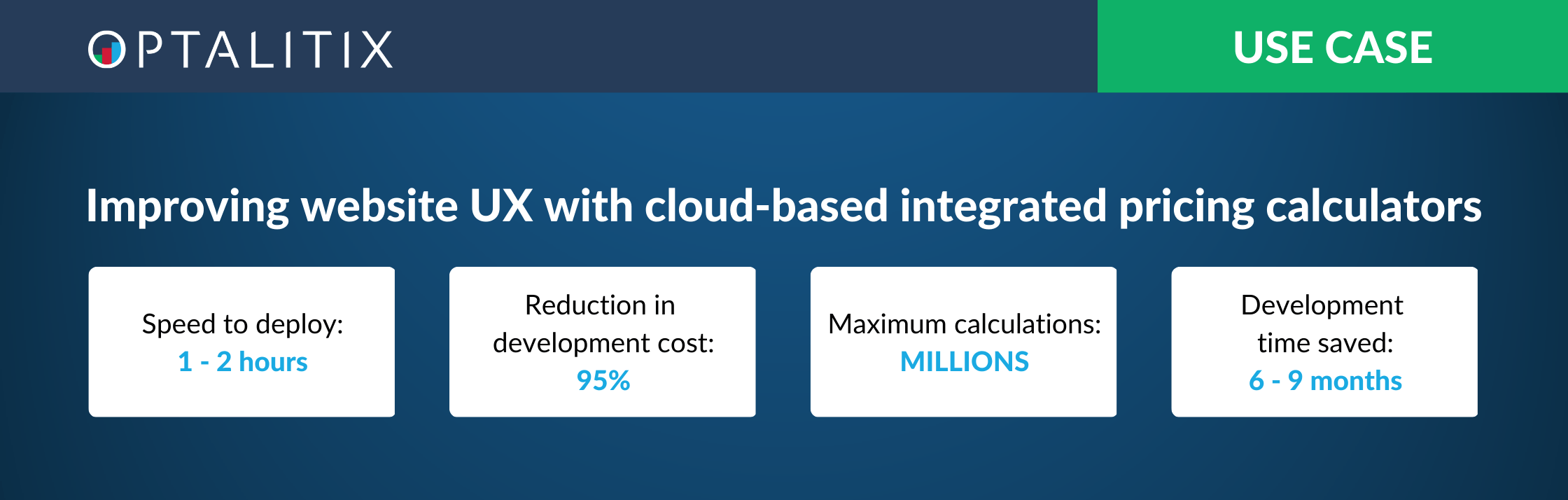
Onespark use case: Improving website UX with cloud-based integrated pricing calculators
Building a pricing calculator into a CRM for Almagro Capital
Almagro wanted a calculator for their products to be built into the Zoho CRM system. Find out how Optalitix Models connected the Almagro CRM system in Zoho here.
Meet Optalitix at Insurtech Insights EU 2023
The Insurech Conference connects insurers and investors, offering an unparalleled experience and access to industry innovators. Explore 2023 Conference insights!
Optalitix appoints Paul Hewitt to their Board following the investment into Optalitix by 24Haymarket
Paul Hewitt has been appointed to the Board of Optalitix, advising on insurance strategy, product development and industry partnerships. Read more in this guide.
.jpeg)
Building a pricing system from a spreadsheet
Have you got an Excel pricing model that you would love to turn into a system? Find out how to build a pricing system from a spreadsheet in our guide.
Optalitix & Avamore launching new lending platform using Optalitix Originate
Optalitix Client Avamore will be launching its new core lending platform using Optalitix Originate architecture. Read more about the platform and its targets.
Optalitix Models integrates easily with Retool to create no-code apps from spreadsheets
Spreadsheet-based calculations representing real-world situations are referred to a models. See how to convert yours into usable application software here.
Optalitix announces that it has achieved the prestigious ISO 27001 certification
OOptalitix announced it has achieved the prestigious ISO 27001 certification by implementing an Information Security Management System (ISMS). Read more here
New pricing standards at Lloyd's require improvements in underwriting systems
New principles for doing business at Lloyd’s will encourage syndicates to digitise their processes, especially underwriting. Find out more here.
Learn about insurance innovation from the DIA conference
The Dia Munich Conference, in 2022, showcased cutting-edge insurance technology, highlighting the growing fusion of insurance and technology in mainland Europe.
Optalitix raises £4m of funding for growth
Optalitix is an award-winning technology business that adds value to financial institutions with low code SaaS products, data analysis and AI models. Read more.