
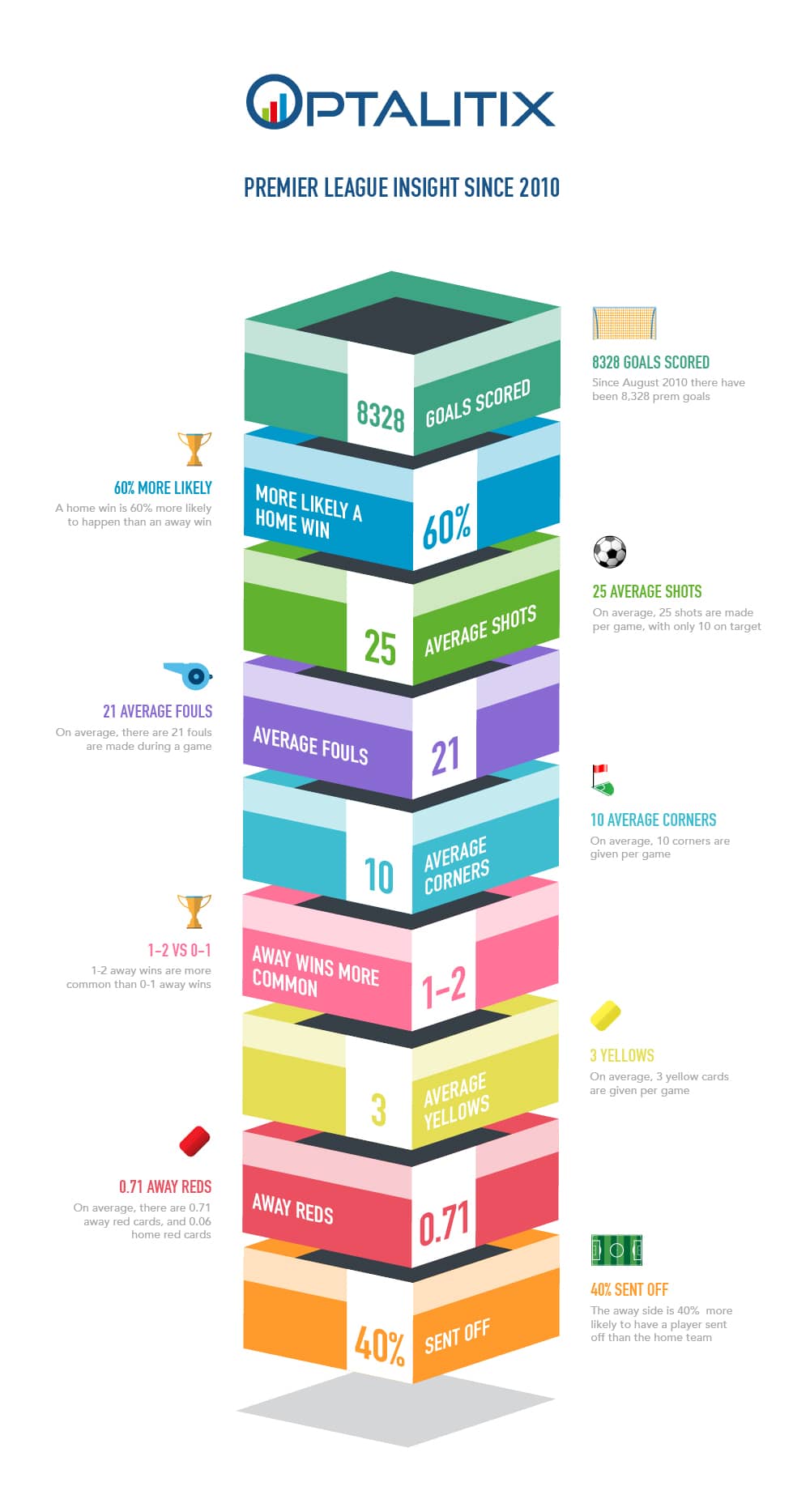
What is the most common Premier League scoreline? What should you expect to see more of in a game, fouls or shots at goal? Which team is more likely to have a player sent off, the home side or the visitors?
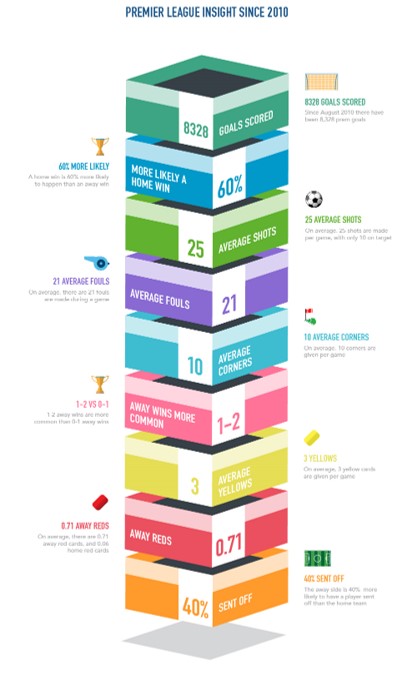
The football fans among you will no doubt have their answers to these questions ready by the end of this sentence. In fact, I reckon that even some of the casual fans will be giving these questions a moment’s thought. If you want to know the answers to these questions – along with many other Premier League (PL) stats – then the accompanying infographic is for you. If, however, you’re slightly curious as to how we got these numbers in the first place, read on.
Still, before we get to the good stuff, we need to go through the proper introductions.I work as an analyst for Optalitix, a company that delivers cutting edge, data based services, including database management and data analytics. I’m also a long-time supporter of a certain PL football team (name withheld for feeble reasons) and if there’s one thing I’ve learnt, it’s that there’s no quicker way than to win a tribal argument lively debate with a rival fan than with cold hard stats.
Why did we carry out this analysis into PL data? There are a number of answers. Football, like all sports, is awash with randomness and probabilities – being the data nerds that we are, the idea of being able to explain away the randomness, and quantify the unquantifiable, piqued our curiosity. We’d also recently finished work on an API modelling tool and were keen to see its application on something other than client data. Football data also has the advantages of being plentiful (if you’ve ever watched a football game on TV, you’ll have seen how frequently statistics flash up on the screen), not confidential and easily understandable by almost anyone who doesn’t live under a rock (or in the USA).
Besides, with the new Premier League season kicking off, could you really blame us for getting a little carried away with the whole football theme?
In order to carry out our research, we obtained historic data for the past 8 PL seasons (2010/11 – 2017/18). We didn’t go any further back – to, for instance, the inception of the PL in 1992 – because we assumed the relevance of the data decreases the further into the past you go (much to the chagrin of all Liverpool/Arsenal/Manchester United supporters).
Once we had compiled the data, we were able to look for key trends and patterns in the data (and settle some age-old debates with various colleagues). The fabled “home advantage” seemed like a good place to start - 57% of all goals are scored by the home side, and victory for the home team is the outcome of 46% of all matches. Needless to say, we soon found ourselves pretty far down the rabbit hole – did you know that Crystal Palace would have been relegated last season if all matches ended at half-time? And that they would have been just 1 point away from European football if only the second half of games counted?
The most common PL scoreline, by the way, is 1-1. I’ll leave it up to you to decide why that is.
Yoni Greis

What are the four types of artificial intelligence?
Reactive machines, theory of mind, limited memory, and self-awareness are four main types of AI categories to be aware of. Read more about them in this guide.
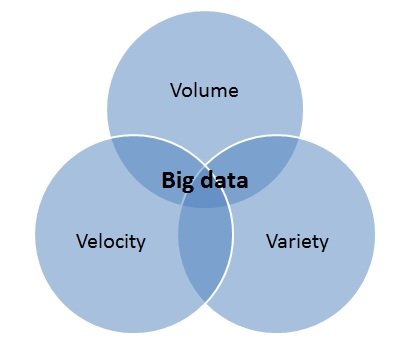
What are the 3 V's of big data?
What are the 3 v’s of big data? Find out more as the data experts at Optalitix explain what they mean by using examples to illustrate each of them.

How to Become a Data Scientist
When pricing a new product, the starting point is almost always Excel. Learn how to create a pricing application from a spreadsheet pricing model here.
Holiday AI Thoughts
The key to selling is to establish a relevant dialogue and understanding with your clients. Find out how AI systems can be used to target the right consumers.
Artificial Intelligence powered insurance is now inevitable!
AI is changing the competitive landscape for insurers by delivering a competitive edge in a number of areas. Read more about AI in insurance.
AI Accessible for all - Ignore at your peril!
As AI continues to develop, businesses of all sizes will need to engage with the technology and embrace the power of machine learning to improve their processes.
The Computable Game
Data analysis with Optalitix—an online underwriting tool offering advanced data-based services, including database management and analytics to insurers & bankers.
AI and machine learning in a GDPR environment.
GDPR refers to the EU’s upcoming data protection regime. Find out whether the anonymisation of data, as prescribed by GDPR, would break AI models and more here.
Cultural diversity drives better AI outcomes
Agile organisations that can respond to the global challenges of their often multinational customer base are often the ones that thrive. Read more in this guide.
Why cant lending be like Uber?
Lending is constantly changing with entrants, regulations and technology. Learn how technology can give businesses market leading edge like Uber in this guide.
Why are Insurers playing a guessing game?
Numerous insurers overlook advanced solutions. Make sure your company leverages valuable insights from its data to enhance the user experience with Optalitix!
The future of life insurance
In the past, choosing the right life insurance was an arduous task. Thanks to data analysis and algorithms, shopping for life insurance has become much simpler.
Insurance quote personalisation is magic!
Dani Katz talks about how Optalitix can improve every aspect of the insurance business through better use of data, quotations and more. Read more in this guide.
A meaningful connection. The next phase of API relationships.
Data analytics and API closely intertwine, but what is the next phase in their relationship? Learn more about this successful financial connection here.