

The Artificial intelligence tool Generative Pre-training Transformer (GPT-3) has gained much attention recently, renowned for its impressive abilities in prescribing medication, designing websites and answering questions.
GPT-3 is the third generation of a machine learning model, automatically learning from its experiences without the need for programming. This tool has been developed by the artificial intelligence research lab OpenAI, comprised of its for-profit OpenAI LP corporation and its non-profit OpenAI Inc parent organisation.
Amongst its array of impressive qualities, GPT-3 is also causing quite a stir after its GPT-2 predecessor was dubbed “too dangerous to release” – claimed to create text indistinguishable from that written by humans.
What Can GPT-3 Do?
Currently, GPT-3 is closed-access, its abilities being demonstrated and shared via social media - the likes of Sharif Shameem showing how the AI can be used to describe designs and subsequently build them, even though the AI has not been taught to produce code.
In addition to this, GPT-3 has also been reported to “auto-complete” incomplete images, using its database to suggest the pixels that are believed should make up the whole of the image.
GPT-3 holds such capabilities due to the fact it’s been trained on the Common Crawl – an archive of the internet with a near 1 trillion words of data.
Whilst GPT-3 was made available commercially last month, work was still required to explore how the tool should be used, head of policy Jack Clark stating: “We need to perform experimentation to find out what they can and can’t do”
“If you can’t anticipate all the abilities of a model, you have to prod it to see what it can do. There are many more people than us who are better at thinking what it can do maliciously.”
Whilst this tool has received impressive reviews, some suggesting it could be a threat to the industry, with others even going as far as claiming it’s showing self-awareness, Sam Altman, the CEO of OpenAI has commented that this “hype” is “way too much”.
“It’s impressive (thanks for the nice compliments!) but it still has serious weaknesses and sometimes makes very silly mistakes. AI is going to change the world, but GPT-3 is just a very early glimpse. We have a lot still to figure out”.
Researchers at OpenAI have also commented that ‘GPT-3 samples [can] lose coherence over sufficiently long passages, contradict themselves, and occasionally contain non-sequitur sentences or paragraphs.”
Whilst the tool has received a glowing response by many, praising it for the innovative capabilities it has showcased, Altman and the OpenAI researchers is not alone in acknowledging its weaknesses and “silly mistakes”. Computer scientist and former Facebook employee Kevin Lacker has shown that the tool is unable to answer questions that humans would find obvious, whilst also not being able to distinguish questions that are “nonsense”, answering them as if they were not.
For example, to the question “How many eyes does my foot have?” the system has been reported to respond “Your foot has two eyes”, whilst asking it “How many rainbows does it take to jump from Hawaii to seventeen” yields the result “It takes two rainbows to jump from Hawaii to seventeen.”
It’s important to note that these machine learning algorithms do not exactly think and understand the language that they are communicating through, and are rather creating a response based off its examination of huge syntax databases. This can lead to such nonsensical responses as those given above.

How to get underwriting efficiency. Workflow and the underwriting workbench
Improve underwriting efficiency with Optalitix's workflow and workbench expertise. Our tools handle various processes, quotes, and large underwriting departments.

A practical guide to underwriting workbenches
Explore how our underwriting workbench aids insurers in handling incoming risks, monitoring their risk profile, and aligning management with their risk appetite.
Optalitix celebrates 10 years!
Optalitix products now available on Google Cloud Marketplace
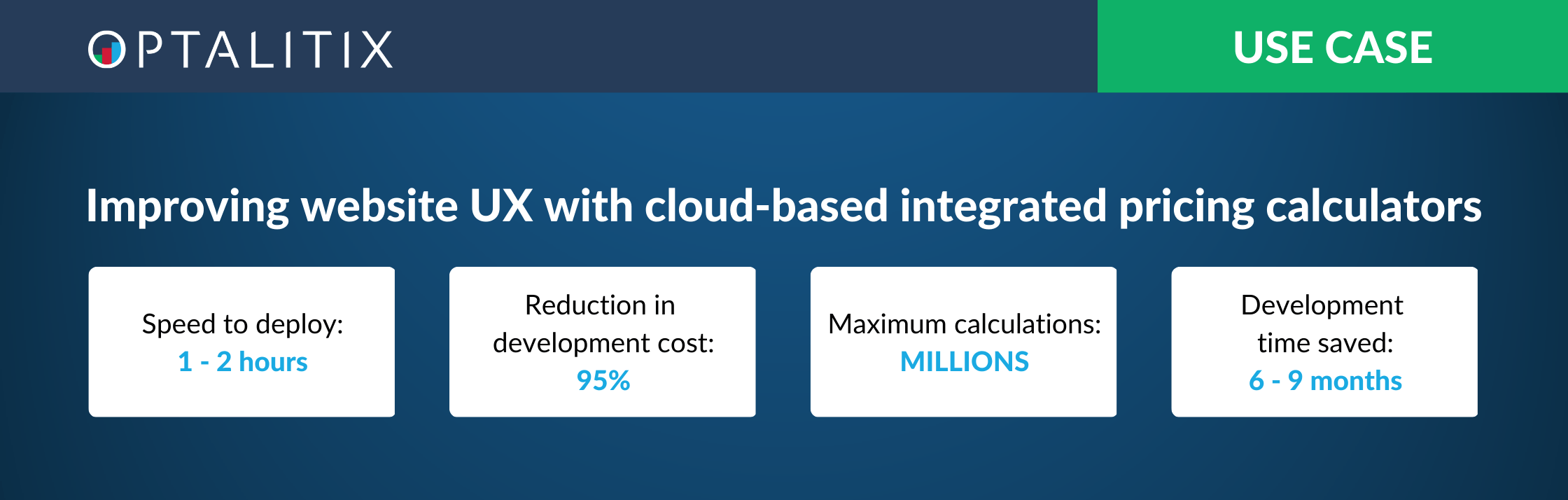
Onespark use case: Improving website UX with cloud-based integrated pricing calculators
Building a pricing calculator into a CRM for Almagro Capital
Almagro wanted a calculator for their products to be built into the Zoho CRM system. Find out how Optalitix Models connected the Almagro CRM system in Zoho here.
Meet Optalitix at Insurtech Insights EU 2023
The Insurech Conference connects insurers and investors, offering an unparalleled experience and access to industry innovators. Explore 2023 Conference insights!
Optalitix appoints Paul Hewitt to their Board following the investment into Optalitix by 24Haymarket
Paul Hewitt has been appointed to the Board of Optalitix, advising on insurance strategy, product development and industry partnerships. Read more in this guide.
.jpeg)
Building a pricing system from a spreadsheet
Have you got an Excel pricing model that you would love to turn into a system? Find out how to build a pricing system from a spreadsheet in our guide.
Optalitix & Avamore launching new lending platform using Optalitix Originate
Optalitix Client Avamore will be launching its new core lending platform using Optalitix Originate architecture. Read more about the platform and its targets.
Optalitix Models integrates easily with Retool to create no-code apps from spreadsheets
Spreadsheet-based calculations representing real-world situations are referred to a models. See how to convert yours into usable application software here.
Optalitix announces that it has achieved the prestigious ISO 27001 certification
OOptalitix announced it has achieved the prestigious ISO 27001 certification by implementing an Information Security Management System (ISMS). Read more here
New pricing standards at Lloyd's require improvements in underwriting systems
New principles for doing business at Lloyd’s will encourage syndicates to digitise their processes, especially underwriting. Find out more here.
Learn about insurance innovation from the DIA conference
The Dia Munich Conference, in 2022, showcased cutting-edge insurance technology, highlighting the growing fusion of insurance and technology in mainland Europe.
Optalitix raises £4m of funding for growth
Optalitix is an award-winning technology business that adds value to financial institutions with low code SaaS products, data analysis and AI models. Read more.