

In the future, workplaces could be fundamentally different from what we experience today, with technologies in Artificial Intelligence (AI) transforming the world of work for a multitude of different industries.
Whilst the future of the workplace may come with some fantastic adaptations, it could also come with a whole host of new challenges that workers will have to adjust to. Below is a list with some of the main areas of the workplace that AI could change in the coming years:
- Staff collaboration
- Remote working
- Employee hiring and retention
- Business insights
Staff Collaboration
Many believe that human-machine collaboration will become an integral part to future workplaces, increasing productivity and thereby the success of the company. This collaboration could help to speed up many of the processes throughout a business, however, this will only be the case if collaboration runs smoothly.
The future could see a focus in job requirements and desired skills for potential employees, including a know-how of certain AI technologies and how to operate them, as these could become an increasingly integral part to many different businesses.
Remote Working
AI could also help future workplaces to collaborate more with remote workers, improving accessibility so that employees can conduct their work in their homes as effectively as if they were in the office.
One example of this is that AI could also make telerobotics more common within the workplace. Remote workers of the future could be able to operate sophisticated technology from a distance (e.g. their homes), which could completely reshape the way future workspaces function.
What this also means is that employees with a technical and specialist role in the company can have more freedom in where they want to work. This may help to improve staff retention and attract new talent, often looking for this highly sought-after flexibility.

Hiring Employees
AI technology may also help to revolutionise hiring, enabling businesses to analyse large quantities of resumes and social profiles, sifting through to find a precise list of the potential candidates for certain roles.
As well as finding them, AI technologies can also automatically interact with potential candidates, meaning businesses can both find and attract the best talent out there for open positions quickly and effectively.
The future of workplaces could therefore see improved efficiency in the hiring process, both in the quality and compatibility of potential candidates to the job role as well as the time in which they were found.
Business Insights
Workspaces are already gaining great insights into their business through the help of AI; its technology being used to better understand customers, learning how to attract new ones whilst also retaining those that already exist.
Considering the level of this technology now, the future for business insights is looking very exciting, and could lead to an even deeper understanding about how to improve the productivity, and thereby success, of businesses everywhere.
How to get underwriting efficiency. Workflow and the underwriting workbench
Improve underwriting efficiency with Optalitix's workflow and workbench expertise. Our tools handle various processes, quotes, and large underwriting departments.
A practical guide to underwriting workbenches
Explore how our underwriting workbench aids insurers in handling incoming risks, monitoring their risk profile, and aligning management with their risk appetite.
Optalitix celebrates 10 years!
Optalitix products now available on Google Cloud Marketplace
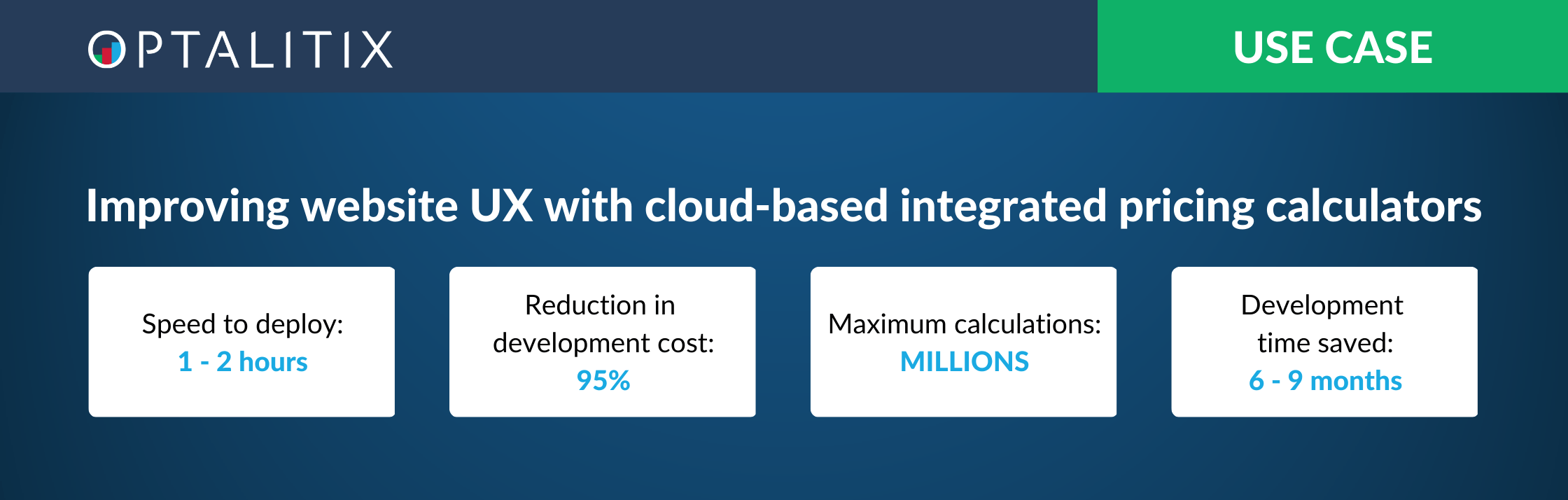
Onespark use case: Improving website UX with cloud-based integrated pricing calculators
Building a pricing calculator into a CRM for Almagro Capital
Almagro wanted a calculator for their products to be built into the Zoho CRM system. Find out how Optalitix Models connected the Almagro CRM system in Zoho here.
Meet Optalitix at Insurtech Insights EU 2023
The Insurech Conference connects insurers and investors, offering an unparalleled experience and access to industry innovators. Explore 2023 Conference insights!
Optalitix appoints Paul Hewitt to their Board following the investment into Optalitix by 24Haymarket
Paul Hewitt has been appointed to the Board of Optalitix, advising on insurance strategy, product development and industry partnerships. Read more in this guide.
.jpeg)
Building a pricing system from a spreadsheet
Have you got an Excel pricing model that you would love to turn into a system? Find out how to build a pricing system from a spreadsheet in our guide.
Optalitix & Avamore launching new lending platform using Optalitix Originate
Optalitix Client Avamore will be launching its new core lending platform using Optalitix Originate architecture. Read more about the platform and its targets.
Optalitix Models integrates easily with Retool to create no-code apps from spreadsheets
Spreadsheet-based calculations representing real-world situations are referred to a models. See how to convert yours into usable application software here.
Optalitix announces that it has achieved the prestigious ISO 27001 certification
OOptalitix announced it has achieved the prestigious ISO 27001 certification by implementing an Information Security Management System (ISMS). Read more here
New pricing standards at Lloyd's require improvements in underwriting systems
New principles for doing business at Lloyd’s will encourage syndicates to digitise their processes, especially underwriting. Find out more here.
Learn about insurance innovation from the DIA conference
The Dia Munich Conference, in 2022, showcased cutting-edge insurance technology, highlighting the growing fusion of insurance and technology in mainland Europe.
Optalitix raises £4m of funding for growth
Optalitix is an award-winning technology business that adds value to financial institutions with low code SaaS products, data analysis and AI models. Read more.