
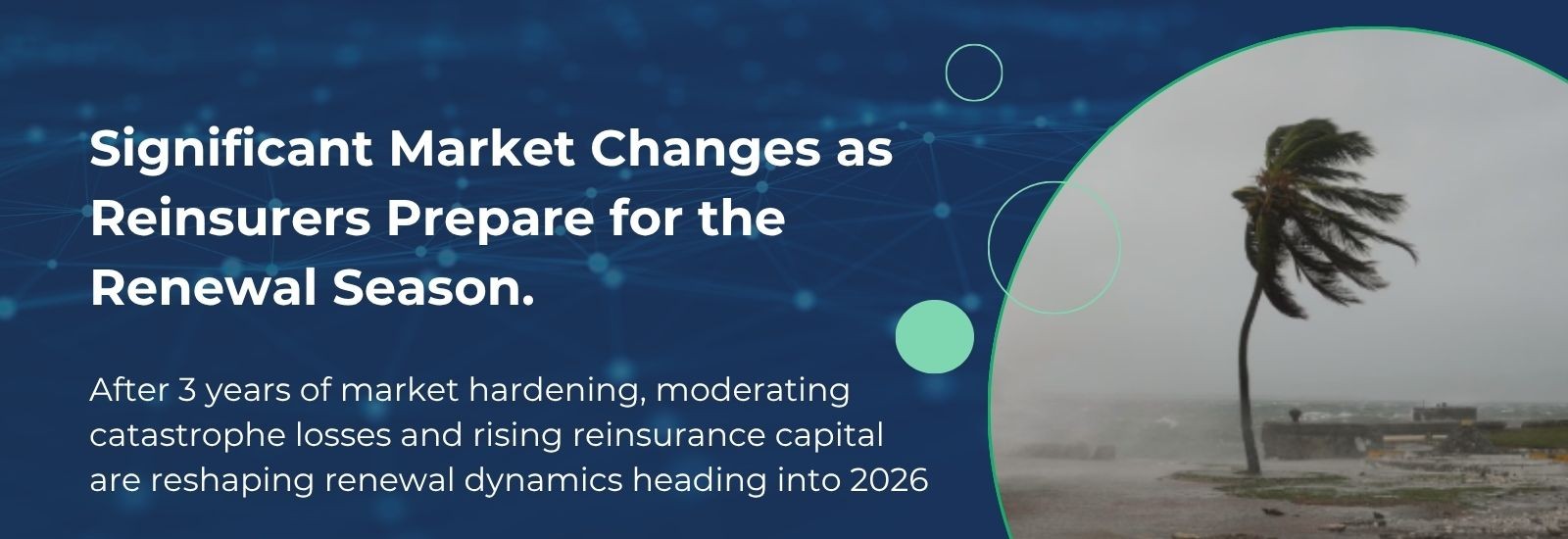
Moderate storm losses bring relief to insurers after years of market hardening
The reinsurance renewal season is here, and the market is changing rapidly to become a buyer’s market after 3 years of a hard market. This has significant implications for all participants, as was evident from a very busy Baden Baden reinsurance conference earlier this month. Reinsurance renewal pricing in 2026 is very uncertain, with significant global implications on direct insurers’ pricing. The 2025 reinsurance claims are an important consideration for this.
The 2025 U.S. storm season has once again tested the insurance and reinsurance sectors. This year’s Atlantic hurricane season, while less destructive than 2024’s record year, has seen high-intensity storms, volatile weather patterns and continued financial exposure across the property and casualty markets. In preparation for the renewals, negotiations are intense and reinsurers will be carefully considering their 2025 insurance and reinsurance losses.
A complex and volatile season
According to the National Oceanic and Atmospheric Administration (NOAA), the 2025 hurricane season is slightly above average, with 13 named storms, four hurricanes and three major hurricanes recorded by late October. It began unusually late with the first system, Tropical Storm Andrea, forming on June 23, the latest start since 2014. Although early activity was modest, August and September brought several intense systems, including Category 5 Hurricane Erin and Hurricane Humberto, both of which broke records for wind speeds and rapid intensification. These, combined with Hurricane Imelda’s flooding across Bermuda and the Bahamas, caused significant localised damage and insured losses.
At the time of writing, Hurricane Melissa is hitting Jamaica with estimates suggesting this will be the most powerful storm of 2025 and the strongest ever recorded to strike Jamaica. Melissa is classified as a Category 5 hurricane with sustained winds up to 175 mph (280 km/h) and rain totals approaching 40 inches in places. Its slow speed is having a magnifying effect with flash floods, landslides and extensive infrastructure damage. Jamaica, southeastern Cuba, Hispaniola and southern Bahamas are all affected.
The U.S. mainland has so far been largely spared from major direct hits, which has helped to moderate total insurance losses compared with the catastrophic 2024 season. Economic losses from global natural catastrophes in Q3 2025 were “exceptionally low”, according to Aon, at $34 billion. Of this, insured losses amounted to $12 billion, the lowest quarterly figure since 2006.
Ryan Specialty’s September 2025 market review noted thirteen U.S. catastrophe events exceeding $1 billion in insured losses during the first half of the year, including fire and flooding events that dwarfed early tropical activity. These losses demonstrated how climate-exposed lines remain under significant pressure, even outside of headline hurricane events.
Expanding market capacity
For insurers, the 2025 storm season came amid a cautiously optimistic market cycle. Property insurers are experiencing competitive pricing and expanded capacity after back-to-back hard markets.
Reinsurance capacity has expanded notably. Global reinsurance capital rose to a record $720 billion by mid-2025, aided by strong investment performance and renewed appetite among alternative capital providers. Catastrophe bond issuance has surged too, reaching approximately $17 billion in the first half of the year and illustrating how the insurance-linked securities (ILS) market is now a core pillar of disaster risk financing. AXA IM noted in July that, despite concerns about climate volatility, ILS investors remain well compensated, citing careful disaster modeling and broad diversification.
This influx of reinsurance capital has moderated prices following two years of rate hardening, though future volatility cannot be ruled out. Meanwhile, players such as Chubb have benefited from relatively low catastrophe losses this quarter. Chubb reported a pre-tax cat bill of $285 million, down from $765 million a year earlier. Such results show that even in a moderately active hurricane year, underwriting discipline and broader diversification have paid dividends.
The changing nature of catastrophe risk
While the U.S. largely avoided a direct hit from Category 5 systems, 2025 has reinforced the broader climate and claims management challenges insurers face. Warming ocean temperatures and other factors are altering storm formation zones, producing frequent rapid intensification events and higher rainfall totals per storm. This is complicating traditional risk modeling and making landfall risk increasingly difficult to predict.
WaterStreet Company’s 2025 hurricane season report noted that average insured losses from natural catastrophes in the US have risen 90% over the past decade to more than $33 billion annually, driven by urban expansion into high-exposure coastal regions and mounting reinsurance costs. These pressures have encouraged insurers to push for stronger building codes and more investment in flood defenses and resilient infrastructure, both of which are key measures to limit both insured and uninsured losses.
Long-term implications for insurance and reinsurance
Looking ahead, there are challenges but also cautious resilience. Swiss Re’s NatCat 2025 analysis projected global insured catastrophe losses could reach $145 billion this year, sustaining the long-term upward trend in weather-related claims. The U.S. continues to account for the majority of global insurance losses, which attributed $84 billion in first-half losses largely U.S. related. This ongoing dominance highlights America’s central role in shaping reinsurance pricing cycles worldwide.
Renewals heading into 2026 are expected to reflect a more balanced market. If storm activity remains moderate throughout November, reinsurers may enter 2026 with increased confidence around capacity deployment, potentially easing global rates. However, Moody’s warns of latent effects as flood and infrastructure claims can take months to finalise, with supply chain inflation continuing to elevate repair costs.
Outlook and lessons learned
As the 2025 Atlantic hurricane season nears its end, it can be characterised as a test of models and management rather than capital endurance. While activity levels were slightly above average, the relative containment of losses has highlighted the insurance sector’s growing operational resilience and the reinsurance industry's adaptability through alternative capital channels.
Yet the broader trajectory is unmistakable with climate change continuing to drive volatility. The frequency of billion-dollar storms, even without widespread landfalls, reinforces that underwriting, modeling and pricing must remain disciplined.
There will be a lot of actuarial head scratching and some hard conversations. I expect that at the end of it, we will see premium rates come off their historic high rates but still very profitable, benefiting cedants and policyholders alike. In 2026, as more capital enters the reinsurance market, expect increased competition for business. There is also a small chance that the reductions in the run-up to 1/1 become more chaotic as reinsurers fight for market share.

Optalitix partners with CannGen to revolutionise underwriting for a fast-growing industry
To boost pricing platform adoption in the London Market

Leading the Pricing Software Transformation
Start 2025 with a game-changing opportunity!

Wishing you a healthy, happy, and prosperous New Year
Thank you for all your support and collaboration
Adapting to 2025 Insurance Changes: Key Insights Inside
Navigating Insurance Trends: Outlook and Opportunities

Optalitix and PwC announce strategic collaboration
To boost pricing platform adoption in the London Market

Supporting Camden Foodbank’s Christmas Appeal
Help us bring hope and nourishment to those in crisis this holiday season by donating food or contributing online. Together, we can make a meaningful difference.

Highlights from the 2024 GIRO Conference
Exploring Data Strategy, Pricing Innovation, and AI Trends in General Insurance at Birmingham’s ICC

Optalitix partners with Insurance Knowledge Hub to boost insurance industry technology skills
Enhance your skills in underwriting technology today

Meet Optalitix at GIRO 2024
Join leading experts to gain insight into key issues, emerging ideas across the of the actuarial profession.

Optalitix partners with Burns and Wilcox to deliver industry leading technology
Optalitix Quote Software to deliver improved efficiency and insights across the Burns & Wilcox Property, Casualty & Terrorism Portfolios
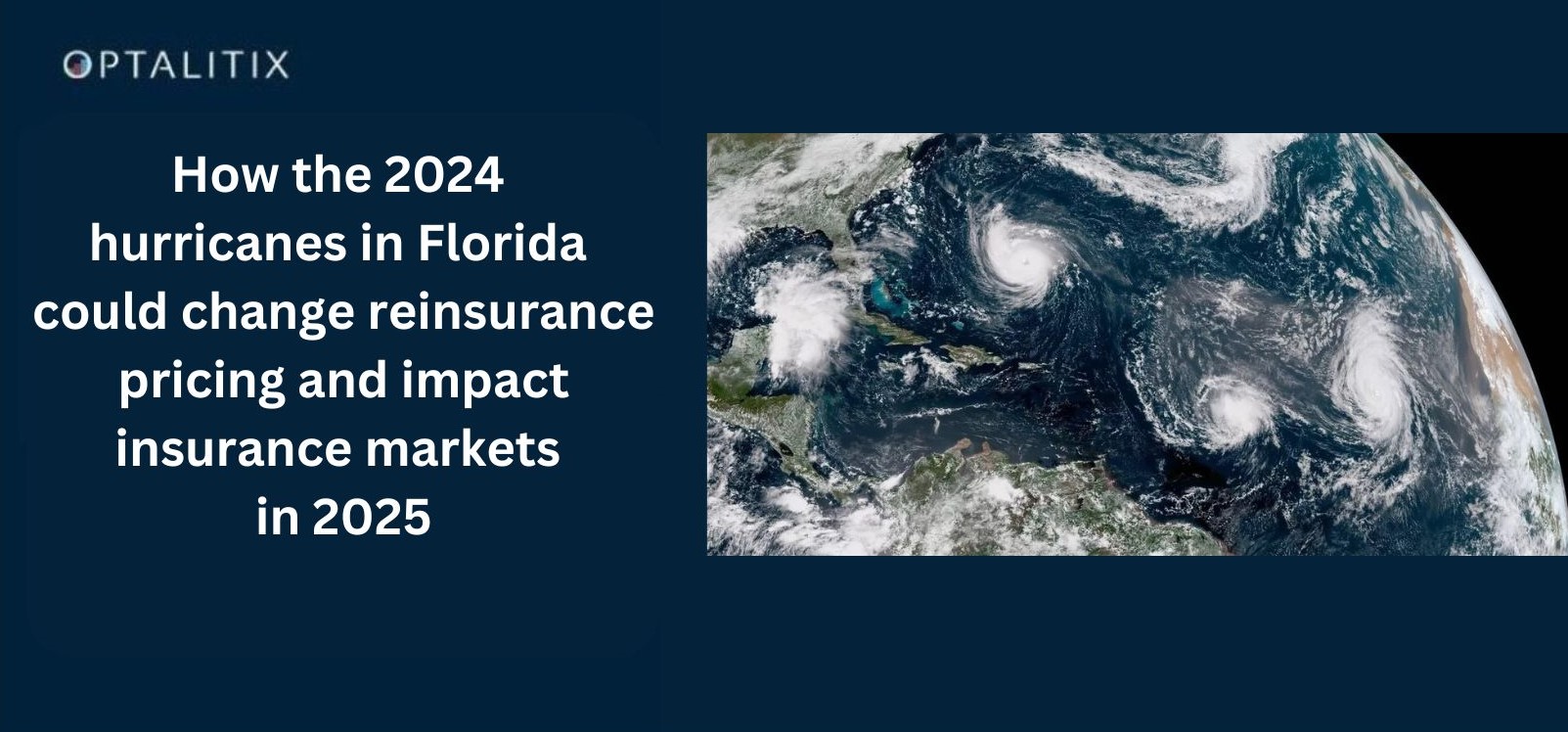
Hurricane Helene - a blow to price stability hopes?
How the 2024 hurricanes in Florida could change reinsurance pricing and impact insurance markets in 2025

Les Rendez-Vous de Septembre: a window into reinsurance renewals for 2025
The key for 2025 renewals is maintaining pricing discipline. A focus on rate adequacy will be crucial to ensure the right balance between growth and profitability.

Optalitix partners with Go.Compare to offer insurers innovative pricing solution
This will reduce insurers’ system development time and cost, boost speed to market, and enhance pricing optimisation.

Redefining Insurance Pricing for the Digital Age
The way in which risk pricing is being transformed is one of the biggest challenges facing insurers in the Digital Age

Optalitix secures further US$3m led by Calculus Capital to accelerate ambitious growth strategy
The funding proceeds will be used to further accelerate product innovation and support the execution of Optalitix’s ambitious expansion plans.